Sunday, February 11, 2007

El Laberinto del Fauno (2006)


Dir/Writ. Guillermo del Toro
w/ Ariadna Gil, Ivana Baquero, Sergi López, Maribel Verdú


First thing's first with a movie like Pan's Labyrinth (2006): You have to see it to believe it, and if you haven't already seen it, you'll need to remedy that as soon as possible.

It's very hard to go wrong when Alfonso Cuarón is involved with a project, but Guillermo del Toro (who directed this particular project) goes the extra mile to ensure that from beginning to end it is a work of integrity worthy of the passions and innocence of youth, the foibles of tyranny and the eternal struggle to find something pure and safe and lasting.

In short, he has created a classic film.

Those familiar with the fantasy genre will recognize that this film lies somewhere outside of the standard categorization, both in content and in context: set up like a folk tale that could easily have been taken from For Whom the Bell Tolls, our young heroine must brave the tasks set for her by a faun of the underworld despite the brewing storm of Francisco Franco's Spain. Caught between a stepfather whose fanatic loyalty to Franco's dictatorship parallels his indifference to his new wife in everything but to produce a male heir, Ofelia must accomplish what Pan sets her to do or face the consequences of her own mortality. And when the daughter of the king of the underworld has been charged with duties to prove her identity, she must arise to the occasion.

The terrific thing about a film like this is its universal scope. At all levels, it registers with deep and hidden truths about childhood and growing up and the constancy of humanity to maintain a struggle between good and evil, despite ages of evidence arguing that we should give it up. The allegory of the labyrinth operates not in the mists, though, but in the reality of never knowing what's right around the bend. Like any good coming-of-age tale, that's the abiding rule.

Fans of the fantasy genre may need to adjust their expectations a bit. Legend, The Dark Crystal and The Lord of the Rings -- even The Chronicles of Narnia (although the PBS version of that story still carries the brass ring) -- each have their specific places in the movie-going consciousness. Even films with varying production values and themes, such as Conan the Barbarian, Conan the Destroyer, Red Sonja, Krull and Clash of the Titans can say roughly the same thing. This film, imbued with life by incredible writing prowess and a childlike savvy, leaves the clichés and typicalities to the past, beating a new path for the international scene.

And while one well-made film's not enough to go on -- to get your hopes up that this will start a cultural revolution -- it's still some pretty exciting stuff.

Labels: , ,

Thursday, October 26, 2006

Flags of Our Fathers (2006)


Dir. Clint Eastwood
Writ. Paul Haggis; James Bradley, novel
w/ Ryan Phillippe, Jesse Bradford, Adam Beach, Barry Pepper

In a breath-taking reinvention of the war film, Clint Eastwood’s Flags of Our Fathers depicts the less visible elements behind war through the experiences of three seeming heroes. Ryan Phillipe, Jesse Bradford, and Adam Beach re-enact the masquerade three soldiers are asked to perform after a prematurely victorious claiming of Iwo Jima ends with bloodshed. The snapshot of the event is sent back to the States for mass production where it becomes iconic overnight, spawning a false sense of closure. The shift in public perception as a result of the now-famous image tells the story of a war that bankrupted the treasury, forced the FDR administration to inflate the economy with freshly minted money, and brought three soldiers home to sell war bonds vis-à-vis their new glory.

Half-truths are the stuff of wars and Flags breaks no knuckles to dissemble that fact. The lies revolving around the three soldiers’ tour bear the burden of the story’s larger context, the reflection of war’s presumptive deceit. Emotions brought to heel by the scope of what each soldier has been through acts as the focal point for the film’s inter-cutting between the trenches of Iwo Jima and the anti-climactic stadium tours for the American public. Embodying the more frenetic emotions is Beach as the real-life Native American soldier Ira Hayes, who had wanted to stay on the front but gets shipped home for the war effort instead. Getting drunk night after night, Hayes spills their general reception to the horrors of public ignorance as much as, if not more than, the horrors of war.

And horror, precisely, informs Eastwood’s landscape, not action. By taking the verbal subtext of the standard war film format out, and replacing it with a suspenseful sense of the macabre, he has isolated war as singular acts and experiences with repercussions on a personal level that may not have been visually discussed before Flags. Soldiers crouch in pockets separated from their fellows with darkness, smoke, and distance. Guns emerge from Japanese turrets with painstaking separation from their unseen operators whose aim is uncertain but a sure and calculated defense against an overwhelming invading force.

That Eastwood never stoops to overwhelm with sheer numbers in battle, nor with epic CGI landscapes, credits the director’s intent and casts a quiet, new light on an already impressive and understated filmography. That’s not to say that Flags doesn’t employ effects where needed, nor that they aren’t magnificent when applied; but the focus remains on the inner turmoil and its translation to the audience member as a participant in a war that pulled attention in so many directions, in part to avoid facing the grim truth and the grimmer realities of World War II. America and the world have seen the bloody combat scenes time and time again in war films. Eastwood lays those impulses aside to set the tone and the space to go someplace new, unexplored, and ultimately languageless.

That undiscovered country will emerge of course in his follow-up segment, Letters from Iwo Jima, which will appear early next year from the Japanese viewpoint. A decidedly good and fresh idea, the echoes of the first installment should still be sounding softly by that time, a reminder that a new outlook on an old and still unresolved problem always exists in the eyes of the searching. My gut tells me that Letters should bring that home.

Labels: ,

Sunday, September 24, 2006

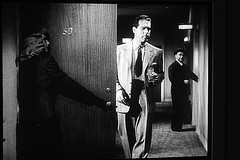
Double Indemnity (1944)


Dir. Billy Wilder
Writ. Billy Wilder, Raymond Chandler; based on James M. Cain's novel
w/ Fred MacMurray, Barbara Stanwyck, Edward G. Robinson, and Jean Heather

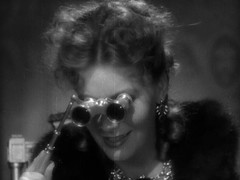
Trying to reconcile himself to the person he's closest to, insurance salesman Walter Neff surrendurs the truth of the events leading up to a fraudulent scam in which his lover's husband can produce a golden egg by dying accidentally on a train. The voice over narrative, ever reminiscent of the opening scene of Neff careening recklessly to get to the office, leads a suspensful and introspective domestic nightmare. As he's pulled ever deeper into Phyllis Dietrichson's machinations -- sympathizing with her dread of the abusive, alcoholic terror awaiting her at home -- he learns that all is not as it seems. Their lopsided love affair staggers between the twisted passion that arises at the prospect of ridding the world of one man and the thrill of plotting a scheme that would go all the way, no hiccups, straight down the line.

If ever a writing duo wove an unsung swan song, Raymond Chandler and Billy Wilder did when they penned this lush but terse and often powerful landmark film. [1] Although owing a lot to earlier noir-like flourishes, Double Indemnity remains an enigmatic foreshadowing of the subsequent emergence of American crime novel fixation in Europe, and film historians usually diagnose this as the first complete noir expression. [2]

All the elements of classic filmmaking, though, combine to render an intriguing and unparalleled feature that bears, as part of the ironic legacy of its title, the dual blessing and curse of reflexive history. In response to its less than immaculate reception at the Academy, Wilder sank his disappointment into his follow-up, The Lost Weekend (1945), which snagged the same majors as rival Leo McCarey for Going My Way (1944). Wilder's competitive nature probably explains most of the seeming jest of experiencing a sense of personal failure for not having made it big at the Oscars, even in light of the fact that until the 1960s, the Academy Awards were considered by more than just the Hollywood sector of the industry to be the last word in quality. Taking in the film as a whole, however, leaves a question as to what kind of director couldn't simply take pride in his work, award winner or not.

For one thing, Fred MacMurray turns in a to-the-letter performance as the salesman taking the irresistable challenge of the ultimate sale, kindling his obsession with perfection. Barbara Stanwyck, burdened with the necessity of playing off not only her co-star but the voice over, radiates an alternating little girlishness and an older woman's aloof but accessible charm. The combination's heady and alluring and wouldn't be equaled again until Mike Nichols's The Graduate (1967). But Edward G. Robinson's little man, Barton Keyes, brings a character to the screen so rich with nuance and mannerisms that his naturality as the anchor of this small insurance world oftentimes goes completely unnoticed. It's as if the sun may rise and set elsewhere, but in the black and white world of eternal noir night, the bottom line sets the bar.

To counteract that direction and to give the film a bit more breadth, perhaps, we're introduced to a fourth character, Lola, Phyllis's step-daughter. She brings back some of the daylight and a naive quality that leaves her fragile and confused, only the appropriate reaction to the world spinning out of control around her. Descriptions of sensory influences blend with Lola's simple presence in the film as a reminder of everything that the insurance business purports to protect but instead betrays.

It's so easy to be debauched by Phyllis and Walter's seductive relationship that it's even easier to forget their penchant for murder, thanks to the incredible work of cinematographer John Seitz and the chemistry between MacMurray and Stanwyck. Every gesture, every glance, charges the air around them with intrigue and excitement so compelling that even the smallest objects around them transform into conduits for those feelings. The stacks of canned goods on the grocer's rationed shelves become Aztec cities; the phone booth transcends its geography to suggest howling winds that must be hushed into reverence; and honeysuckle smells famously like murder.

The most awing and humbling act arrives when, having been caught up in the dirty business of covering up their crimes, Neff does his best to make things right. He may be a little late, but after all the madcap racing around, his effort speaks quietly of a man who recalls that life offers more than the option between the grind or a heist. Partly due to Lola but mainly because no man likes to be tricked by someone he cares about, the film's finale reverberates with the simple reminder of things that all of us need to be able to count on but can take for granted way too much. Even those not easily succumbing to the thoughtless whispers of a dark and dreary night in nowhere.


[1] Crime novelist Raymond Chandler wrote the screenplay for Alfred Hitchcock's Strangers on a Train (1951) in addition to whipping up the dialogue with Wilder from Cain's novel, which was originally entitled Double Indemnity in Three of a Kind. If titles are any indication whatsoever of writing abilities, suffice to say it's a good bet that the film's substantially better.

[2] A year too late to make the grade, Edgar G. Ulmer's Detour (1945) struck a similar note as a classic that would be all but forgotten upon release, only to be dug up by film historians who, presumably, preferred the indie director to Wilder.

Labels: , , ,

Friday, September 15, 2006

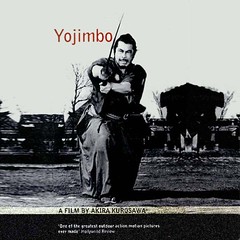
Yojimbo (1961)


Dir. Akira Kurosawa
Writ. Ryuzo Kikushima, Akira Kurosawa
w/ Tohiro Mifune, Tatsuya Nakadai


A samurai was many things in his lifetime: a protector of the realm, a defender of the ruling party, and the iconoclast to whom all other classes gave honor. In Yojimbo, he's also the scruffy wanderer who seeks to find a new place in which to sharpen his skills before they rust, and to do so with as much tact as possible. When Sanjuro walks into a town which has been taken over by a sake dealer named Seibei and a silk dealer named Ushi-Tora, he finds just such the whetting stone for his talents. The merchants, appraising the recent fall of Japan's last dynasty as a time for greed and corruption, have been busy raising their stations by collecting gamblers as cutthroat bodyguards and attacking the farmers who once supplied their trade. Although the samurai has been bereft of food and away from the ruling family he once protected with his life for an unsubstantiated amount of time, he takes his time, sizing up the atmosphere and events carefully. It is a new Japan. One of the merchants has kidnapped a local farmer's attractive wife to negotiate for his son; but, it is a time of social disorder and chaos. It is a time when some parents advise their son to kill to win the respect of men while yet others advise staying on the farm and reaping an honest day's work.

Eh, parental expectations can be heavy, you know?


Samurai as Loner: a Study in Contradiction

Humility comingles with self-sufficience in the lonely, wayward manifestation of Tohiro Mifune's chest-scratching, abrasive Sanjuro. His very name, pulled from the mulberry fields that are the conspicuous focus of his enigmatic stare, elicits a sense of dissipatory elusiveness that supercedes all of his actions. When he lets the stick fall where it will and follows, he acknowledges that his destiny lies outside of his hands. Like the restless, roving, and ultimately crumbling samurai class to which he belongs, though, this unforgettable visual component acts as deft commentary on the unforeseeable -- but just as precarious -- future of Japan.

Keiko I. McDonald's extensive look at the historically-based but aesthetically licensed milieu Kurosawa creates in Yojimbo explains the four-tiered class system as having the samurai at the top, followed by the farmer, with the artisan and the merchant comprising the bottom, respectively. [1] Having been abandoned by the Tokugawa Shogunate's corruption and collapse, the classes have been left in the rapacious lurch of the feudal system, Sanjuro included. "Kurosawa's camera, focusing on the protagonist's back for an unusually long time, evokes a sense of claustrophobia," writes McDonald. "At the same time the white family crest in the center of Sanjuro's black kimono becomes fixed in our minds." Even freed from his masters, this suggests that the samurai was still burdened with the honor expected from one of his ilk though it fails to benefit him in any tangible way. Alone, hungry, and unemployed, he moves on.

The town he arrives in has been overrun by merchant-class opportunists -- a sake dealer and a silk dealer who have each conspired with gamblers in an effort to amass muscle power and outdo the other. Ever aloof to those he claims to despise as weak and defenseless, Sanjuro appears to play heartless games of mischief as he sets the merchants and their men against each other. The open conflict this generates between the two factions acts as representative of the hard realities of that time. Despite his outward enjoyment of the goings-on, though, his alternate side emerges to reveal the inner hero. Tough love is deeply ingrained in his bluff sense of altruism, and deep down he's a role model as well as the protector of an abandoned people he loves.


Samurai as Mediator: the Strategist vs. the Humanitarian

Perhaps the most curious aspect of Yojimbo, Kurosawa's carefully constructed removal of Sanjuro from the story's more criminal elements, deters the audience from seeing the samurai too closely, nor too disjointedly. Effectually, the audience sees much through his eyes while still being allowed the advantage of telling camera work that plays all over Mifune's physique. In a studied scene in which he learns all about the town and its oily operations, Sanjuro and the old man who feeds him pace around the interior of a hut in the foreground while the middle ground remains largely empty of action and seemingly devoid of life. In the back ground, in deep focus and employing a playful Japanese sense of mise-en-scène, the merchants' men grease the official inspector's palms with money and flood his tea cup with sake. "In this town, I'll get paid for killing," Sanjuro ruminates as he watches these subtle announcements of the deterioration of his culture, "and this town is full of men who are better off dead."

Yet, Sanjuro still finds humor in the buying-off of the officials; it's the deeper aspects of cultural erosion that trouble him. The silk merchant's prayer chanting for the death of the sake merchant denotes the perversion of religion. McDonald's observation succinctly grasps the tension of these scenes: "As the coffin maker's hammer and the silk merchant's prayer drum beat together on the sound track, we realize that religion, traditionally the answer to death, is no longer an answer or a solace; that, ironically, death is the 'answer' to 'religion.'" The palpitations of the steady march of time in an era of decline reverberate throughout Yojimbo's stark landscape, signalling a sort of death pall that Roger Ebert summed up well when he wrote, "Shutters, sliding doors and foreground objects bring events into view and then obscure them, and we get a sense of the town as a collection of fearful eyes granted an uncertain view of certain danger." [2] As the audience, perhaps, we are immune to that fear; it has, though, at very least become a tangible and calculable presence among the marginalized and deserted townsfolk.

Further exacerbating the face of death in isolation is the dual irony presented by Sanjuro auctioning off his services as bodyguard to the highest bidder. For one thing, all things monetary are beneath a samurai's dignity; that he must pretend to an ignominy that he doesn't come by honestly holds irony enough. His choice of masters, though, betrays his true ingenuity. Seemingly, by offering these services at all, he validates the self-importance that these bosses draw to themselves while what he's really doing is using it against them to complete the ruse. It is the people who must be protected from the war-mongering merchants who have superceded their place in society and shunned the farmers and artisans whom they once depended upon. It is the emerging middle class that Sanjuro elects to pick out, then, by using their own vanity and opportunism against them however he can in order to save the true people of Japan.


Samurai as Paragon: the Transitional Navigator

No mere sorter of souls, though, Sanjuro's egalitarian view shines through, especially with regard to the decisions all men must make. He never pretends to be more than what he is: unemployed. His fellow samurai, although in a seeming position of disgrace and laziness, prompts his respect as a fellow loner and entrepeneur. The swift reduction of the merchants' houses essentially reduces its leaders to opposing vices. Humor remains the ultimate mediator between murderous intent and natural justice. By not backing down from a pistol clearly aimed at him, Sanjuro cedes the right of way to destiny, even if it means death, and even if it's his own. This singular aspect of the samurai's prescience of mind and honor in times of crisis touts the grand ideal that that sort of warrior has inspired generations since. His tacit gravitation to where he's needed most could be argued as the happenstance of a life spent defending royalty and personifying nobility. That would be a good argument. It would be better, though, were we to see that the farmers and artisans left behind by the collapse of the last Japanese Dynasty made the people, in this time of sorrow and change, his new and implicitly truest royalty.


[1] McDonald, Keiko I. Swordsmanship and Gamesmanship: Historical Kurosawa's Milieu in Yojimbo. Literature Film Quarterly, 1980, Vol. 8 Issue 3, p188, 9p; (AN 6906904)

McDonald interviewed both the famed Kurosawa writer Donald Richie and Yojimbo cinematographer Kazuo Miyagawa and drew heavily on Richie's Japanese Cinema: Film Style and National Character and The Films of Akira Kurosawa.

[2] The incomparable Roger Ebert.

Labels: , , , , ,

Tuesday, September 05, 2006

Little Miss Sunshine (2006)


Dir. Jonathon Dayton and Valerie Faris
Writ. Michael Arndt
w/ Greg Kinnear, Alan Arkin, Steve Carell, and Toni Collette

Co-directors Jonathon Dayton and Valerie Faris's mini-epic family romp acts much like the mirrors set in tiny rooms to gain a sense of space. Like many indie films, Sunshine uses time and plot sparingly, yet it does so in such a way that leaves the viewer with the feel of a full film. Greg Kinnear plays a father and self-help speaker trying to push his spiel national. Nursing home reject and Grandpa Alan Arkin is a bad boy druggie and sexpert who coaches his pageant queen-hopeful granddaughter (Abigail Breslin) Olive's dancing.

Enter Uncle Frank, an irresistibly terse Steve Carell, a disgraced literature professor freshly returned from the hospital on suicide watch to bunk with his morbid, mute fifteen-year-old nephew. When asked why he's stopped speaking, Dwayne (Paul Dano) points to a wall-sized caricature of Friedrich Nietzsche in reply. It's off to the funny farm from there, each character's personality colliding with the next as though this were a stage play in which everybody's a little bit twisted. And then there’s the Mom (Toni Collette) who wants nothing but honesty in her family and what's best for her kids.

The stage-play elements of the opening might normally come off as a bit trite, but this cast makes it work. In a noteworthy moment, the camera kneels along with Dad. Bracing his young daughter's shoulders, he wrings from her the promise that their trip to California to enter her in the “Little Miss Sunshine” beauty pageant will end triumph. Olive puts on a brave face and the family piles into the reliable old microbus for a cross-country run.

From there, we are plunged into the soups of human trials that smacks a bit of The Grapes of Wrath and films like Home for the Holidays. This family’s emotional challenges and achievements are so earthy and unpretentious, the humor so warm and sweetly lighthearted that big things become small and manageable. Where another viewpoint might have mired their problems in a more depressing model, Michael Arndt’s debut script takes daunting family issues like suicide and drug addiction and provides them with a very human and watchable perspective.


But despite all of their traumas, the connection between family members remains its main attraction. Whether it’s a depressed nephew standing on a pier hearing his uncle proclaim Proust a loser, or at-odds family members heaving-to as a unit to start the family bus, their frailties dissolve within a context few comedies bother to provide. It takes Sunshine to a level that soars.

These aren't people simply motivated by family obligations, though, any more than a random hodge-podge of emotional dysfunction. They're folks who have been tried by fire and have come out on the other side to want what's best for one another. Without even trying, the film tugs at the Little Miss Sunshine in all of us through its characters, asking us to be better people and to start by remembering to enjoy the world and those around us. When you're trying to snag the elusive limelight in a beauty contest, that's precisely the kind of crew you want in your corner.

Labels: ,

Tuesday, August 29, 2006

Water (2005)


Dir. Deepa Mehta Writ. Deepa Mehta
w/ Sarala, Lisa Ray, Seema Biswas, Kulbhushan Kharbanda, John Abraham, Vinay Pathak, and Waheeda Rehman


Stories take on a life of their own. The truest story is the simplest gesture, capable of betraying the greatest depth of feeling while also conveying the complex of nature of life. This can be as elementary as a mother peeling potatoes for a famished, captive audience or an anxious husband preparing a cold compress for his feverish wife. The moments these tasks take appear profound, monumental. In many ways, Deepa Mehta's Water reflects her intuitive sense of storytelling, but too tragic a history has hamstringed her full potential to tell it well. Her film's riddled with the woes of a culture on the precipice of a change that did not and has not reached all the strata of its society any more than Gandhi made true believers of all of his people. Foregoing for the moment any detailed understanding of Hinduism or Indian culture, the plight of women in a religious austerity that doesn't necessarily hold its men to the same rigidity at very least translates well to the Western grasp of relationships and the presence of imbalance.

Not unlike the songs of Solomon, the Ancient Vedas -- the poetic basis upon which ashrams have become a customary part of Indian society, and the film's focal point -- put women on a pedestal of virtue that most humans would agree is a tough row to hoe. With specific evils befalling women who do not toe that ascetic line, though, the Vedas go beyond the realm of the early Jewish poets. Where Solomon and David after him felt on safe ground praising the idyllic, virtuous woman -- not coincidentally often a frugal one, easily adaptable to the rigors those in nomadic, uncertain times faced -- the Indian poets seem to have instilled a stronger sense of justice into their writings when evoking karma. Perhaps realizing that she would be trying to reach an audience more accustomed to open, interpretable Scriptures, one in which God and not a poet had the final say, Mehta stays close to those things common to both East and West.

Both hemispheres value the happiness of children. Both admire the pursuit of dreams. Possibly as a result of the indelible mark of British Imperialism, India seems to have the same weakness for tragic love stories that many Westerners have likewise inherited from the same sector. And both have an Industrial Machine constantly churning out fodder to compete with The Last Greatest Thing Since You Can't Remember When. Thankfully, Mehta's work doesn't pander to the ranks and files of Hollywood any more than it does to Bollywood; it does, however, hit you over the head at times with its message. I'd hesitate to label it preachiness. What I think's really happening is a sizable mistrust that her audience will understand the most important thrust of her film. As agenda art, if you will, it's very powerful in ways that have not even been broached yet; as the fine, spoonful of sugar that critics so long for when dealing with an epidemic of misogyny, it's disconcerting and a bit hard to take.

The first question that comes to mind is why, if the abject cruelty to widows in India is so important, did the filmmaker choose fictitious film as her medium? Why not a documentary?The answer may be as facile as roving differences in ticket sales between non-fiction and feature films, an evolving thing since Robert Redford launched Sundance Cinemas and instituted the House of Docs as a permanent part of his annual film festival. Although the public response to such ventures has risen, along with the visibility of such filmmakers, the change has been dramatic without being sufficiently encouraging. Westerners still seem to prefer their movies fake, entertaining, and -- more often than not -- a tad schmaltzy. So let's discuss Water for what it is: a piece of timely art that attempts to span an intimidatingly wide cultural and societal gap using little more than the universal truths and echoes found in all stories involving humans, and a medium that nearly every country in the world has now at least begun to test.

At the foreground, Chuyia, the newest acquisition in a house of widows or ashram, presents us with everything one could ask for in a heroine. She possesses spunk in spades and a child's clairvoyant honesty that calmly puts the illusory in its place by asking for a second helping of reality. In the very first scene, her dying husband lays just behind her on a cart as her family treks homeward. All Chuyia can think to do is enjoy the spacious view around her, gnaw on something particularly sweet, and thump the dying man's foot. Such deft characterization is not only Mehta's forté; it's also her wordless argument. The child can not remember being married, but she will spend the rest of her life in an ashram to serve the customs of her people. This ironic metaphor serenades the essential landscape of the film, that remembered sweetness of the wedding feast without the just desserts of a wedding night. As a widow in their midst, despite her youth, Chuyia's accorded the same sympathy and respect sisters grieving would give each other matter of course; but, by way way of human predictability, she also shares their blows.

That's precisely the point Mehta harps on again and again, this monstrous degredation to which women in captivity become subjected and eventually used to, treating each other in a variety of ways less dignified than wouldv'e been witnessed in their former lives. As widows, they are meant to comfort each other in their grief. Not only have they been forsaken by a God they once trusted to bless them with children and a home, but they have been insulted by a husband who chose to leave them behind rather than spend as much of this life with them as possible. It recalls the Native American belief that aborted babes, and not their mothers, choose to dwell on this earth or not. That Western difference in thinking that we are so very in control of all of our choices touches the depths of this film's more intuitive perspective on life.

Since not all women are the same, each copes with her situation as she can. The virtue of each woman expresses itself in the way she views herself, as the victim or survivor of a bad beat. The lines get blurred in places, but that line of distinction remains Mehta's crux as she attempts to appeal to the sentiments of a society so fundamentally different from our own. The attempt even works, as one of the women takes Chuyia under her wing to teach her to cope and to protect her from being used by a widow who has turned sour. An element of alienation also stalks the screen. As the women struggle to survive, we see Mehta's firm belief emerge that Chuyia, although strong and independent, hasn't a woman's sensibilites nor awareness of the ways of the world; and, what's more, she doesn't want her heroine to develop that. The need to remove Chuyia from the widows' house augments the filmmaker's sensitivity to the faults in her society's structure. She appreciates the beauty of the Hindu spirituality and has great faith in its women, trusting in their strength and sense of moral duty; but, being mature herself, she knows that evil resides on the earth, and that change must come when a society fails its brightest.

Water -- the universal solvent, the building block of all life, and the only thing that truly quenches thirst -- plays as vital a translational role to an international audience as the theme of clarity does its message of social change. The holy water of the Ganges in which daily ablutions are made holds as much context as the well water and rain. In 1938 India cholera and other waterborne illnesses must've made conditions worse, but Mehta gently eschews all of that, allowing the river to flow in its dual habitat of transformation and renewal. Making love, when two people come together to act as one, can be much like floating. It is the river that must be crossed to keep the rent money steady; from which brides receive blessings; by which old wounds heal; upon which the dead are laid to rest; because of which, ultimately, two lovers separate. In short, it provides just enough catharsis in and of itself to accelerate real change.

By no accident, Gandhi's traveling orations lend the film the same currents upon which to navigate its seamier intrusions into the psychology of female isolation and abandonment. Gandhi's declaration that "God is not Truth, but that Truth is God" feels right somehow, but without any really deep visual connection being made to what's been going on among the widows prior to his appearance. Like the intrinsically mysterious nature of water, his words get lost in their transparency, suggesting an opacity as fickle and fleeting as smoke. In so doing, Mehta doesn't offer any answers concerning the future of widows in India; but, by the same token, she doesn't let us forget that Truth and God, like the tides, wait on no man. More to the gist, Water tells us that change is sure and painful and inexplicable and often quite hard to comprehend, but that when staying still becomes even more so, that change is inevitable nonetheless.


* * * * * * * * * * * * * * * * * * * * * * * * * * * * * * * * * * * * * * * * *


Here's some testimony from a film crew worker for those interested in the cause.

I haven't read much in the way of good, comprehensive reviews of Water, but this one isn't bad.

This guy...well, I'm not sure he even watched the film, or maybe he got some bad subtitles...hard to say, but he does make some nice directorial references that could be appreciated by those working on the 100 films.

Labels: , ,

Sunday, June 04, 2006

La Grande Illusion (1937)

Dir. Jean Renoir
Writ. Jean Renoir and Charles Spaak
w/ Erich von Stroheim, Jean Gabin, Pierre Fresnay, and Dita Parlo

Captain von Rauffenstein guns down Captain de Boldieu and Lieutenant Maréchal's fighter plane over German soil, then receives them at an impromptu lunch to honor the dead. Before the meal can be eaten the French officers, now prisoners of war, must leave for a soldier's camp in Hallbach where the German footsoldiers treat them with civilized military indifference. The French soldiers at the barracks when they arrive have made great use of their time digging a tunnel, and Boeldieu and Maréchal join in, all of them salivating over which appetite of freedom they will whet first. Endless fields of Holland tulips or a quiet glass of wine, each man deprived of such luxuries, spells his sense of beauty aloud, surrounded by the dank gray of isolation. Their common goal having formed them into a tight unit, their disappointment extinguishes their spirits when, on the morning of their planned escape, the news arrives that they will transfer to Wintersborn that afternoon. Any escape attempt by day would mean heavy loss of life, and they care too much about living to try.

At Wintersborn, Rauffenstein adresses the officers -- Boeldieu, Maréchal, and Rosenthal -- concerning the fortress' inescapability and binds them and himself to French regulations in light of their company's less solvent attempts to free themselves at Hallbach. The captains share a bond of the old nobility. They are gentlemen, a dying breed of a revolution based on the basic laws of supply and demand. Left on the shelf to gather dust, Boeldieu acts of his volition when he deems it best, contrary to the wishes of the aging German captain. At the essence of their differences lies the sharp dischord between acceptance of the need for change and rejection of the new sense of humanity. The future rests in the abilities of the commoners for whom Boeldieu lays down his life; for Rauffenstein, however, the only future clear to him are the orders he must give before he, too, can die.

As might be expected from the son of the impressionist, Renoir fills his canvas with the realities of the day-to-day living between members of opposing nations who adhere more naturally to the rules of courtesy than to the pretenses of war. The hypocrisy portrayed by these oppositions does not color the actions of the men who share its burden, for each man has needs and wants of his own. The motivation to live and to return -- to loved ones or to the front -- drives them; and, where no such motivation prevails, as in battle, men sacrifice themselves for those who have more to live for and more to lose. Operating on the belief that time spent with people, looking at and interacting with and appreciating, will always overrule spending time away in a charade as grand or illusory as war, Renoir gives each man a face and a voice and the proper amount of time in which to be seen and heard.

Amid the desires of the men to leave the camp, disparate views emerge from the French officers. Maréchal, a mechanic who deals in how-tos and questions his fellow man no further than to call him brother, believes that mankind can be saved, that it's not too late. War can be stopped, and the warmongers only win if man forgets his humor, his compassion, and his ability to connect. "We've got to end this damn war," he declares, "and make it the last." His companion in escape replies, "Don't delude yourself." To Rosenthal, war reeks of humanity's inability to recognize each other as important and part of a greater plan. Man always fouls the garden, falling further from rather than rushing toward the divine.

For Boeldieu nobility ceases to be a virtue only if he lets it and, though he distances himself from Rosenthal and Maréchal's ranks emotionally and intellectually, he doesn't think twice about paying the greatest price of all to ensure that the free world receives her native prodigal sons. Perhaps the most telling aspect of Renoir's examination of why, in the face of so much capability to get along peacably and still thrive, men still chase after grand illusions, it begs the question, are we truly free? And if so, then why are we so very alone?

Labels: , ,

Saturday, June 03, 2006

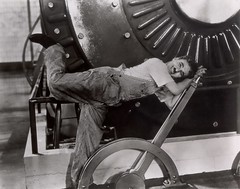
Modern Times (1936)


Dir. Charlie Chaplin
Writ. Charlie Chaplin
w/ Charlie Chaplin, Paulette Goddard, Henry Bergman, Tiny Sandford

Breaking five years' silence after City Lights in 1931, the Tramp returns to work at a steel mill, shipyard, department store, machinist's, and restaurant, the American dream tugging at him. He spends his time trying to stay fed, even if it means going to jail. A run-in with a vivacious, but malnourished street urchin leads to him redoubling efforts in the hope that they can build a home together, but to little avail. Circumstances always emerge that preclude realization, ensuring that he constantly circulates through a maze of entry-level jobs, never achieving anything lasting.

Released thirteen years before 1984 hit bookshelves and ergonomics became an applied science, Modern Times relays startling accuracy and insight into man's struggle with technology. Unable to rest at the steel mill, the Tramp works himself into a nervous breakdown; and, when he lands a craftsman's position at a shipyard, accidentally sinks a half-built ship. Later on, while roller skating as a department store night watchman, a job he got when the old watchman broke his leg, he gets held up by a group of hungry men, one of whom he'd worked with at the steel mill.
Chaplin's apropos commentary on the constraints of industrialization on personal freedom, often sharp, factor in the selling of modernity itself. New technological advances surface like waves and society rushes to catch up with them in vain, stumbling. Social responsibility plays an ever smaller role as money and time dominate its very inventors. Referred to as Chaplin's "crystal ball," his clairvoyance credits his brilliance not only as a comedian, but also as a filmmaker with a wider view of the world and a more salient wit than most.
Yet, despite his full awareness of and attention to the the age of the machine -- or because of -- Chaplin elicits some of the heartiest laughter with this material. His movements balletic and his heroine feistier than usual, his common ails play out with spunk and earthiness. Teetering on the threshold of the ribald, his visual antics possess warmth, depicting the poor blue-collar worker as the salt of the earth. His imparted wisdom, of no mean quality, suggests that when times get so rough that success can only be attained at someone's detriment and is so short-lived anyway, it's more recommendable and just as feasible to live happily ever after as a Tramp.

Labels: , ,

Wednesday, May 31, 2006

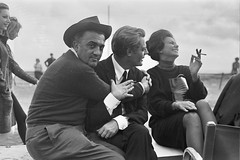
8 1/2 (1963)


Dir. Frederico Fellini
Writ. Federico Fellini, Ennio Flaiano (story); Ennio Flaiano , Tullio Pinelli, Federico Fellini, Brunello Rondi
w/ Marcello Mastroianni, Sandra Milo, Claudia Cardinale, Anouk Aimée

Besieged by an undiagnosed but cloying malady, reclusive director Guido Anselmi searches for his film as obstacles emerge in every form imaginable. Frederico Fellini's afterimage labors under heavy dreams, sifts through an ocean of actresses, and collides with his inevitable frailty while meandering, trance-like, through his production. All the while, as clips of conversations make up the frenetic background through which he tunnels, he exists in an alternate dimension which demands more and more from him as he traverses toward a resolution of the personal, revealing, and bizarre. Favoring the journey for the ultimate sake of destination, Fellini often submerges his director in collective, diasporic memories, some that hold stigma, and some that soothe.

Anything going on outside of Guido's mind becomes passé the moment it occurs in his rut. The actresses gather to catch his attention, but few do. Direct conversation means as much as crystal tinkling at a cocktail party, and he avoids it with disinterest, even to the point of talking to a hapless man just to get away. Due to a subtle capturing, a mastery on Fellini's part, it's often hard to distinguish between the reality of the people in Guido's world and the appearance of them in his mind. Often, things don't connect, and characters barrage, picking at the senses until he retreats back into another dimension. Even meetings crucial to the film's progress, such as meeting with the Bishop concerning representing Italy with the rectitude of his film's themes, don't prevail upon him to leave off his musings.

His inner life preoccupies and drives him to distraction, enchants and torments him with its vivid imagery and guilt-laden layers that blight the more salient moments of his childhood. An early introduction to Saraghina, a garish woman who lives in a sea shanty, conveys his first curiosity in the vigorous female form. As the social and moral outcast dances the rhumba for a coin, the boys cheer, but Guido responds in earnest to the prostitute's visceral daring. The Church then chases him down, finds his disgraced mother, and shames him for lewdness.

Fellini doesn't work it to death. His understanding of Guido as halcyon as moonlit tidepools, the director allows him the freedom earned by a lifetime of inner turmoil to do as he pleases, and he phones his lover. When Carla seems to have missed the train, he shrugs with apparent indifference; but the camera with relief, so that her sudden appearance as the train departs declares a man torn between two unknowns. Although her presence helps him get at least one good night's rest, his mental detachment increases with her dense witticisms even as his body responds with a will of its own. His wife Luisa arriving only a little later, though, seems to bring him angst, shoving his thoughts to the outer realms where no one can reach him.

The essential play that Fellini prepares effuses a desire for the world to be lovely and reasonable, as evidenced by Guido's delight that his wife and mistress, once having spotted each other, take to each other with comraderie and style and genuine affability. But do they really treat each other right, or by way of magic has the camera tricked into reality a whim of the director? Like I said, it's hard to say sometimes. In his secret heart, Guido clings to and cherishes his wife, seeing her simplicity and her strength, the quiet calm at the far end of his restless fantasies. Aware of his seeming emotional destitution, he finds solace in that place.

Yet Guido's film plays out as a trite send-up to that emotional destitution, and during a viewing of the actresses' screen tests, Luisa watches the sad parodies of herself and Carla mutilate lines over and over. None of them can ever bring the same simpering gibberish or that certain je ne sais quoi. The screenings project relentlessly, and the only abatement is the arrival of Claudia Cardinale as a facet of herself, his last hope and savior. When she, too, undermines his fantasy notion of her, Guido faces the novelty of a lifetime of imperfection reflected all around him. Things grow dark, perturbing, and gauntly out of reach, the images fragmenting as Fellini hoodwinks his audience one last time, because he can.

Fellini claimed that his seventh film was only half a film, giving this title its only real significance; the picture, on the other hand, is worth far more than a thousand words. It defines and redefines filmmaking, unabashed by real-life problems, and starkly honest at its depths, so much so that it led the Time magazine reviewer in June, 1963 to write, "Fellini has a singular personal problem: why is he so preoccupied with making movies that speak of the emptiness of life?" But had the writer the opportunity to watch this several times and reflect, he very well may have sung an altogether different tune; one of surprises, inspiration, and joy.

Labels: , ,

Saturday, May 27, 2006

Closely Watched Trains (1966)

Dir. Jirí Menzel
Writ. Bohumil Hrabal (also novel), Jirí Menzel
w/ Václav Neckár, Josef Somr


Stepping into the niche his ancestors have carved for him, Milos begins his apprenticeship as a dispatcher at the local train depot in Nazi-controlled Czechoslovokia. His girl, a train conductor, loves him, and all he has to do is "stand on the platform with a signal disc and avoid any hard work, while others have to drudge and toil." Life is good. But when it's time to make love, Milos suffers anxiety, a misunderstanding of his manhood that leads him first to a suicide attempt and then to a more alluring solution, an older woman.

Milos's quiet acknowledgment of the goings-on around him make for thoughtful viewing. Like a well-made cup of tea, Closely Watched Trains progresses, gently provocative and brimming with delightful moments; insightful, humorous, and brazen. An inspector arrives at the station to show the stomping power of the Reich, reminding the workers that they all have to like each other in order to win, and departing in a car on the tracks, running in reverse.

Later, when Milos's philandering co-worker gets nabbed for tatooing a young girl with official rubber stamps, the Inspector returns to declare the dispatcher's guilt of abusing the German national language as engraved on one of the stamps and displayed on the girl's right buttock. It's wonderful irreverence, the sort of material to be expected from a man some have called the Woody Allen of Czechoslovokian cinema, for both physical and humorous resemblances.

Since 1966, of course, the country has split into the Czech Republic and Slovokia, and a similar hint of division surfaces within the forty-year-old film. The town, station, far away cities and countries exist as separate entities, mere matters of geography. The imposition of the Reich holds little sway over Menzel's individual countrymen. Distance and culture clash raise too high a barrier to make much of an impression beyond the idea that the Germans are pigs who don't know how to treat cattle, let alone people. The soldiers that pass through on foot get afforded the same courtesies as the closely watched trains that arrive almost without origination on one side of the tracks and depart to the unknown on the other.

Menzel's style, influenced by the Nouvelle Vague, retains its integrity by not indulging in the experimental or overdoing technique. True to form, the images flow with the logic of a mountain stream, but with an undercurrent of dark humor contextualized by an unending sensitivity to humanity's weaknesses and shortcomings as well as its surprising strengths. Each take supports the previous and jumps into the next, securing the masterpiece as a lasting monument to its director and its country.

A bold and kind treatment of the enduring reality of the human spirit, it won the Grand Prix at the Mannheim Film Festival and The Best Foreign Language Film Award at the 1967 Academy Awards.

Labels: , ,

Friday, May 26, 2006

Bande à Parte (1964)


Dir. Jean-Luc Godard
Writ. Jean-Luc Godard, based loosely on Dorothy Hitchins's novel
w/ Anna Karina, Claude Brasseur, and Sami Frey

With little going on in Odile's life besides an English class, she quickly, unwittingly ensnares herself in a heist of money from her aunt and guardian's safe. Coquettish looks and misunderstood conversation between a misfit girl and two young men dabbling with the idea of being gangsters at first results in lackadaisical hanging out, but soon turns mean-spirited.

The story, one of bored youth without direction or guidance, is nothing new. A few notable implementations, though, veer this away from a typical '60s romp à la Annette Funicello. Black and white film, for one. It shimmers with high-key lighting, open skies, and white walls; and, while it may not have a lot of honorable intention or content, resistance to smiling at parts can prove futile. Each scene has urgency, due mainly to the "live reporting" camera techniques.

Godard gives the actors little pith with which to mold their characters, an aspect that would've felt asphyxiating to many actors of that time and of today. Karina, for the most part, contours her features into a pitiable frown meant, presumably, to convey a smorgasbord of emotions ranging from confusion to dislike. She frowns a lot. The scenes where the trio enjoy each other's company -- when they dance the Madison or attempt a minute of silence -- feel the most natural, the most credible.

Could this be too much digging into a film constructed to look fresh and cool, and timbred with Michel Legrand's light-hearted Parisian score? Possibly. Godard piecemealed the script together, day by day, using what sets he could and, more often than not, existing lighting. He didn't overly concern himself with characterization, plot, or story development. What his efforts lack in depth and substance doesn't get made up for with realistic cinematography and fresh, rebellious approach.

Hackneyed writing, stringed fragments of pop culture references, may project cool and crisp, but attention to craft serves the cast, crew, and audience much better, providing the respect and structure needed for actors to apply their medium. To wit, although Anna Karina is an undeniable beauty, placing her in front of the camera and rolling does not a feature film make. She does her best, but often resorts to eye-candy posturing.

The most praisable aspect of Godard's work may be that it never purports to be something that it is not. For a couple of other reasons besides this, Bande à Parte didn't get relegated to the arena of kitsch. Since Godard's style changed dramatically from film to film, his pulpy followings never congealed to the thickness of a John Waters or an Ed Wood fan base. He also creates a whimsical atmosphere that remains consistent throughout, the mark of a good director, if not a great writer. Perhaps the best moment arrives when Karina sings on the subway, a sad song that reflects her state of mind more than it supports the story.

An irony exists that helps to bridge the comprehension gap between contemporary French filmmaking and the old New Wave. Jean-Pierre Jeunet's Amelie, despised by many a self-titled film buff who will readily claim any of Godard's pieces as an automatic better film, nods to him while also upstaging the New Wave giant. On the whole, Jeunet creates a more interesting, character-supported, and sweetly rendered peek at French filmmaking. Why? Attention to detail, involvement of the audience in the experience, ideals posessing no substitutes.

What Godard has put down for posterity often looks good, but fails to deliver in any tangible way. The sites of Paris, the offhand innocence of a young girl, and the excitement of being in a "band of outsiders" holds universal appeal to youthful decadence, an audience that bemoans the perception of the grass always being greener on the other side of the pond. In reality, though, Bande à Parte does little else to conjure the imagination or inspire.

It ends, as it began, at nowhere, but at least the journey held some little magic as it went along. Perhaps that, more than an overt reaction to the mainstream filmmaking of the time, held the greatest importance to the writer. I liked the middle parts most.

Labels: , ,

Thursday, May 25, 2006

Yes (2005)


Dir. Sally Potter
Writ. Walter Donohue, Sally Potter
w/ Joan Allen, Simon Abkarian, Sam Neill, Shirley Henderson


Before the young lovers set eyes on each other, the houses of Montague and Capulet had sealed Romeo and Juliet's fate. That sixteenth century prism of an unobtainable co-existence of peace and love sets the proscenium for Sally Potter's (Orlando) heady exposure of modern conflict as laid between two souls, Yes.
A middle-Eastern man takes daily affronts to his pride in a London kitchen. A scientist from Belfast vis-a-vis America, long fallen out of pleasure with an absent husband, explores the capacity of living cells to discern their destinies. They meet, partaking of a private intimacy just beyond the noses of the surrounding public, and all the tumblers unlock. Amid an interracial argument about to come to blows, the cook loses his job and he breaks off the romance and retreats to Beirut where he reclaims his original profession as a surgeon. Meanwhile, her marriage untenable, the woman who raised her dying, the scientist reaches out to him, unwilling to part ways despite the grief and despair.
The choices Potter's subjects make both visible and audible, she reveals these hidden lives with a piquantly honest social acumen, contrasting them through a variety of means. Whether or not to voice fears, who to confide in, and when to keep secrets secret comprise Yes's core. As the determined heroine, Joan Allen waxes and wanes with more juice than usual. Parisian theatre production company owner and co-star Simon Akbarian presents a persuasive stage charisma with a loyalty to the verse that unfolds the tale. Although his approach translates to film as threadbare at turns, he plays off Allen's feminine sense of creature character with such skill that the decision's overlookable, more so than the stilted lines of the supporting cast, especially the kitchen crew. His mysteriousness and instinctual timing produce an exotic masculinity that emaciates only marginally when confronted with his insecurities.
In keeping with the erotically charged atmosphere, Potter also scribbled in the housekeeper, whose musings both tantalize and give pause for reflection. "Dirt never really goes away," she says, "It just gets pushed around." Like all living cells with a destination, she minimizes her role in the play, making herself very small yet resourceful. Fishing a condom from a toilet and carrying away stained sheets, her observations bring marked heat to an existence rife with infidelities for all the right reasons, not to mention the strains on a man who would like to be rid of the third wheel as much as he would his third-world image. Two people can't hold each other responsible for all the wrongs of the world, but love does tend to leave its targets vulnerable to all.
Raw and vital, Yes shares the soil of human thought in textured transitions that vary from nickelodeon epiphanies to deep sea swells, just like the gamet of human emotion. Totally aware of the horrors constantly impeding the planet, Potter reaffirms the diminishing line between objectivity and individual perspective. Since human understanding will always be subject to interpretation, objectivity can never be isolated and defined. All anyone can ever do is try, whether she be a scientist devoted to quantification or a man obsessed with his identity.
Unlike the bard's ill-fated lovers, the scientist and the cook-cum-doctor choose to live in this uneasy world, not without fear. The tides have shifted since the days of Capulet and Montague. Their ultimate separation gains no peace, bridges no cultural gaps. Their destiny lies bound together, as intertwined as the futures of all nations; such is Potter's vision for peace, one of the most recommendable in years.
Parting may still be such sweet sorrow in the twenty-first century, but it can't be nearly as sweet as togetherness. Yes individually conquers the notion that everything must have a price, exhorting its audience to believe that, for once, this isn't just another movie, or even the stuff that dreams are made of, but that peace can be as free and clear as love.

Labels: , ,

Saturday, May 20, 2006

Saraband (2005)


Dir. Ingmar Bergman
Writ. Ingmar Bergman
w/ Liv Ullman, Erland Josephson, Börje Ahlstedt, Julia Dufvenius


When Lawrence Kasdan sat to edit the funeral ensemble The Big Chill, he became increasingly aware that the film's impact would be breached if he kept the deceased's living flashbacks in the cut. Upon completion, all shots of Kevin Costner had been removed, leaving only the telltale hairline that more attentive devoteés would recognize in later years. It also hauntingly retained a sense of the unknown, the unforeseeable, and muted and simultaneously strengthened the piece's ghosted legacy.

Bergman attributes the idea to Alf Sjöberg, Sweden's greatest filmmaker until his own career unfolded after writing Hets (Torment/Frenzy) for him. "What is half-hidden," Sjöberg told his young protégé, "is far more suggestive, more seductive, more exciting than what is fully visible." The theory rules the prevailing body of Bergman's work; but, in Saraband, he brandishes it with a tangible relish, relating each character's life to the death of one woman in the past.

Considering the story material, the decision to abandon the rule governing actors eyeing the camera creates a unique relationship between the audience and seasoned veteran Liv Ullman as divorce lawyer Marianne. She confides to the viewer her skepticism comingled with her desire to visit her former husband, even as she's approaching the final steps to his sun-basking side after decades of separation. What follows is the great echo of youth in a grouchy maturity, as the two rediscover each other. In their halcyon reunion scene, Marianne brings up his cranky days at university, which Johan dismisses, admitting that he'd been "gummed up in the standard academic nonsense," but that everything had changed when he received his honorary doctorate from the University of Michigan. Later, she tells him that he's like some "forgotten character in a stupid, old film."

Both jests display Bergman's deft humor at work.

Bereft of the daughters she had with Johan -- one lives in Australia, the other vegetates in a home -- Marianne opens maternally to the last generation, the young cellist, Karin. The fast bond with Johan's motherless granddaughter from his first marriage proves life-changing as, two years prior, the girl's mother died and left an inconsolable and vulnerable widower alone with her. Fogged and disadvantaged, Karin has found herself in a sexual imbroglio with her father. Marianne's simple ear provides the necessary candlepower for the girl to make a cathartic move that offsets the lives of her father and grandfather. Thus the two men have lost the common thread -- the girl's mother -- and in so doing, the stage has been set for what storytellers the world over refer to as "the thing."

Using vignetted narrative, woven together as classical movements, Bergman carefully develops this portrait of some of the most brittle family relations ever to get caught on film. Grudges and death have demanded more tensile strength of these characters than any of them had to give, but for one who died. In the Swede's native tongue, he gave this her name, that of his mother: Anna.

What the world has been given, at the end, is hope. Realism provides the backdrop for Bergman's final adieu to the silver screen, but hope drives it home. Whether you remember this as a parting gift to generations of admirers and enthusiasts or as a simple love sonnet to a wife one filmmaker fears he may never see again, you may rest satisfied that you are in the hands of a very wise man who has lived a full life and knows what it is to love.

Labels: , ,

Tuesday, May 16, 2006

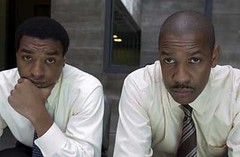
Inside Man (2006)


Dir. Spike Lee
Writ. Russell Gewirtz
w/ Denzel Washington, Chiwetel Ejiofor, Jodie Foster, Clive Owen, Christopher Plummer, and Willem Dafoe

Whomever had the job of showing Denzel Washington the script for the first time must've left the actor's side, ears ringing with voluptuously bell-like peals of laughter. Gewirtz's story gives us Frazier, a detective under investigation for a missing sum, enough to buy a Staten Island condo. He then lands the negotiation of a hostage crisis in the middle of the Manhattan financial district, a chance to prove worthy of command that he and his eager partner both jump at with zeal; however, the robber has already told us in all confidence at the beginning of the film that he has planned the most brilliant, perfect robbery, leaving little doubt in the audience's mind that all will go according to plan. Ah, and therein lies the rub. We like Frazier within seconds and want to see him win the day, but Gewirtz has also cleverly circumvented the pitfall of the genre by taking away every question but the "how?" In short, Washington got handed all the elements of a perfect role, where the outcome becomes a minor point at the very start, and the journey to it excites all the more, because it's the only thing that matters.

Politically charged yet witty, the filmworld's angriest auteur may actually have been prescribed this script by his therapist. What it renders for posterity in terms of interracial content it also winks at with the humor necessary for anyone wishing to remain a long-term citizen of America's most stressed-out boilerpot of a city. No stranger these days to suave machismo, Washington steps into this sweet spot of a role designed to supply an African-American actor the same ethos as a Serpico or a Michael Corleone, a Columbo or a Sam Spade -- only black and beautiful. And Washington executes Frazier with gusto, aware of the detective's limitations, but spot-on with the attitude and persona peculiar to a man trying to make pay-grade in a city police force that's suffered in the public eye. He even infuses a mild accent into the role to make things more fun. It might make you want to shout, "Hey, Washington, your Brooklyn's showing, Baby!" in the middle of the theatre.

Lee suitably makes no show of humility when presenting the Big Apple. Loud music, an Indian melody overlaying an invincible rap beat, takes us into the heart of the action and sets the tone fairly aptly. Russell Gerwitz's tight script blends the New York vernacular of "Giuliani Time" with a sense of poor showmanship that must be overcome. The synthesis makes for a heist movie that leaves the audience with a slightly new take on the genre; Matthew Libatique's now-expert photography takes up any slack that may have been leftover. With a license to return to basic student film techniques, he uses effective jump cuts and 360 degree panning, not to mention a great instinct for knowing when to shoot from outside of a room rather than inside. Armed these days with a higher budget and the eternal confidence of carte blanche on a Spike Lee joint, Pi and Requiem for a Dream credits tucked long under his belt, his style works beautifully, and in waves that separate each act distinctly yet elegantly.

One of the more impressive feats of the film, Clive Owen's turn as the mastermind, overcomes the basic challenge of characterization without much interaction through subtle writing and innovations in presenting a robbery. This script offers unusuality in such a way that the actor's work deals mostly in being completely full of himself, as at the opening when Owen stares down the camera to deliver a monologue brimming with detached triumph and worthy of Olivier.

Artistic elements aside for a moment, though, Lee possesses an incredible knack for timeliness. Although the characters portrayed in Inside Man are fictional, they are based on real-life figures. We've seen these people before. They're Madison Avenue Ivy Leaguers who live in the same city with beat cops without ever mixing -- the shaken and changed who walk the streets below the penthouses of the indifferent and uninterested. They're the citizens of a city without a common identity but which struggles to find one in the post-9/11 world.

Although this film remains Washington's chance to swagger and shine, Lee doesn't take the New York out of the New York. Tensions and paradoxes shade Inside Man with nuance and talking points, as if the director were lifting up a bit of the grid, placing it into our palms, and asking, if we were to live here, what the hell would we do? It's a damned good question, Lee. In a world where bank heists of perfect proportions will always be a work of fiction, it's good to be reminded of what's real.

Labels: , ,

Friday, May 12, 2006

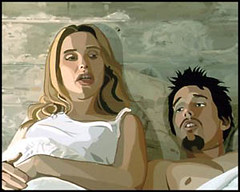
Waking Life (2001)


Dir. Richard Linklater
Writ. Richard Linklater
w/ Wiley Wiggins, Caveh Zahedi, Julie Delpy, Ethan Hawke, Steven Soderbergh, et al.


In a moment of pure self-actualization around the turn of the millenium, Waking Life entered the troposphere of social consciousness as naturally as though it had been hovering there always, with the implicit promise to stay just as long. Linklater brings us to a place, never more than a thought away from a young man full of questions, each answer bringing him a little more towards consciousness without guaranteeing him absolute reality. He begins with two children playing a fortune game. You remember the carefully folded paper with colors and numbers and, in the innermost folds, your secreted life's story? For this particular boy, "dream is destiny," and -- how true; for, of course, that boy is but a fragment of a larger dream that the main character, the questioner, finds himself waking up in, layer after layer, as his increased appreciation allows him to navigate his dreams more and more freely.

Recurring dream characters ebb and flow throughout the dreamscape, but the thread of questioning remains his constant divining tool, that hint of awareness that breathes of its own accord. One moment, our dreamer may be delving into postmodernism and, the next, into "the new evolution." Using simple voice-over, a classical ensemble, and a visual style that defies categorization (but how about "beautiful") Linklater accomplishes in a short time what many filmmakers can not in several expensive hours of reel: sort of stream-of-consciousness meets "what I wanted to talk about with my friends all my life, but..." By leaving characterization to the elements of argument and reason, the work becomes audience experience, allowing a rare peek into the writing process without muddying the cerebral quality of this fine work.

Yet, of all of Linklater's films, this one endures the most criticism. Ardent fans of other pieces supply the words "pretentious" and "glib" when avoiding eye contact and serious discussion. And while Dazed and Confused catchphrases have become household words, this little prize gets scuffed around and ignored. Could it be that audience resistance to the experience offered here waxes oxymoronic, that not allowing this artform to wrap and lull and awaken you somehow commits the highest pretentiousness of all? In a society obsessed with empty, mind-numbing entertainment, is it possible that we've forgotten that art's primary objective is to imitate life? Truth be told, this filmmaker takes it a step further.

Art interacts with life.

Oh, it's not the life of schedules where characters know the mundane details of each other's lives, like where they work or what kind of car they drive: none of that holds any import. But the body language of the characters conjures up such a sense of the spiritual, an inescapable and indefinable reality that gets portrayed best perhaps in a superb scene of a movie house showing the film Holy Moment. Caveh Zahedi shows that every moment in life, like in a movie, can be holy by staying open and committing to the moment, beginning with just two people. But then, of course, life kind of stops, gets put on pause. You stop talking. You feel. Like the experience of committing yourself to a theatre for a couple of hours or so, that's always time you'll never get back.

Which is why, when Linklater fills this with the aggregate of his experiential thought, what we get doesn't merely justify our participation in Waking Life; it challenges our approach to everything. Every minute detail that you thought was so important the last time you opened your mouth dimishes and your senses are lent to focus and imagination, which is precisely the difference between art, which is meant to supplement and to teach, and static, which is just more resistance. As Speed Levitch tells us, "We are the author of ourselves, co-authoring a gigantic Dostoevsky novel starring clowns." Life happens and sometimes, it is very, very funny. But it never really stops. A layer of perception always awaits us, right around the bend.

Labels: , ,

Wednesday, April 12, 2006

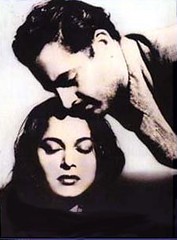
Pyaasa (1957)


Dir. Guru Dutt
Writ. Abrar Alvi
w/ Guru Dutt, Waheeda Rehman

Throughout his contemplative study of a poet out of place among his people, Guru Dutt presents the film community with the state of modern India using the story of one man as a sort of tressel board. Personifying the aforementioned poet, Vijay, Dutt manages to quietly comment upon the effects of British Imperialism while also conveying his great feeling for his culture. Vijay haunts the streets of his village like an apparition until he hears Gulab, a lady of the night, singing one of the poems that his brothers have turned into waste paper for a trifling. Now intent upon publishing the remainder of his work, he gets a job for a man who harbors ill will against him, the man who married his college muse without attaining her love. When Vijay runs into Meena, his lost muse, the heavens open up in a choreographed musical number, the kind which would provide a benchmark for many a future Bollywood production, albeit in color.

To say that despite the black and white medium, Pyaasa engages and maintains the viewer's senses adequately rings true enough, but the cinematographer's use of light and dark sequences that change with the narrative sets terrific tone. In an encounter with a huddled, starving untouchable, in which Vijay gives up his jacket, the frames grow so dark that certain bits look directly influenced by early horror films like Nosferatu. His poems, all of which he sings, set the pace of the film, each more beautiful than the last. They seem to speak of a land of loveliness lost and nearly unreachable largesse of the soul in the wake of the caste system. Of course, as McNelly pointed out, without the subtitles, a lot gets left to the imagination. Somehow, though, Dutt's masterpiece grasps a full range of ideals and absolutes in such a way that Pyaasa still acts as a complete film without them. The melodies help out, yes, but mostly the filmmaker deals in plot and paradise, from the opening shot of the poet enjoying himself by watching a bee buzzing around in the grass one moment, but getting trampled underfoot by a passerby the next.

The rest of the film unfolds the nature of the man himself though the lens of his country. College-educated and middle-class, Vijay should garner the respect of his peers, but he can't even expect that from a restauranteur. A rich weasel getting into his automobile mistakes him for an unskilled laborer when he tries to help him with his parcels, and makes a show of complaining about the educated having to work like that, but still hands him a counterfeit coin as payment. The only people who recognize and hold him dear as a simple human being removed from more desirable economic circumstances walk the streets just as he does. One of the most delightful and unexpected of these provides comic relief, the plight of the common man, and several necessary distractions in the form of Sattar, a man who gives hair oil massages for pennies. These scenes provoke laughter without any wincing at cultural sterotypes. Dutt's simply much too bright, focused, and purposeful to rely on any such blemishes.

Possibly, the spiritual implications of Pyaasa serve its legacy best. Dutt himself had a hard time emotionally while filming, going through a split with his wife that may have been exacerbated by rumors that he was having an affair with leading lady, Rehman, as the exotic Gulab. His solid, consistent presence makes sense in light of such tidings, his mental state adding to the torment that the film demands of him. He uses grating comparisons to further heighten the scope of the drama. As he drunkenly grieves, a young mother is coerced into continuing dancing although her baby cries for her. Dutt and Alvi's sense of the state of man and of India leave little to criticize. If anything, his commentary opens a floodgate of questions that have nothing to do with politics, economics, or any of the affairs of government, but rather of the unknown and how letting go can be good. Whether or not he saw the beauty of his own work clearly enough to carry it with him always can not be known, though; the revered director died of an overdose of sleeping pills in 1964.

Labels: , ,

Saturday, March 25, 2006

Gone With the Wind (1939)


Dir. Victor Fleming
Writ. Based on Margaret Mitchell's novel, and Sidney Howard's screenplay w/ no credit to Ben Hecht, David O. Selznick, Jo Swerling, John Van Druten
w/ Vivien Leigh, Clark Gable, Olivia de Havilland, Leslie Howard, Butterfly McQueen


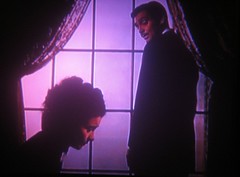
The mixed reactions this film's very mention usually elicits from folks holds both merit and misconception. Certainly this is a film dealing in most part with the South and the Civil War and all of its various repercussions, but darker elements at play here involve, mainly, the roles of women in an ever-changing and often hostile, unpredictable setting. Southern dramas all the way back to colonial times usually seem to involve sniping women who take potshots at each other hushedly but must maintain a colossally gracious poker face while among polite society. To do anything else could disgrace the family name or, worse, pull their most hidden thoughts into the open, allowing society to dismiss them as the imps that the very system essentially renders them. Adding to this ridiculous and frustrating social paradox, their roles don't get better after they get the men they're trying to, as in order to get what they want from their husbands, they must resort to sexual manipulation as though it were course de nature. In this context, the women never seem to develop any real maturity, strength of character, or lasting independence from the vulgar, tasteless monopoly that tradition and the unchecked power of male dominance has handed to them like a plaything. In this sense, slavery gets expanded to the context of all Southerners, but especially to that of females. It's just social custom that if a woman wants to be thought of as such that she must constantly prove her powers of conquest, whether she does so openly or not.


That being said, while most historians may agree that women and children are the first and foremost victims of war, in the case of Scarlett Katy O'Hara quite the opposite is true. The war is in many ways her freedom and her grace. It provides the distraction required for her to detach from a pre-ordained role and outgrow it in leaps and bounds. That's not always obvious while watching the rash little vixen, of course. Vivien Leigh pursues the less likeable qualities of the often dubious heroine with gusto, a gale force to be reckoned with at every turn of the camera. And my, oh my: the camera guy had his work cut out for him. Watching her sometimes it's not hard to think that she really might be on coke or at least some seriously concentrated ephedrine. Somewhere between her doting father who'd do anything to try and make her life more harmonious and her more rigid mother who'd prefer her daughter just make her proud, though, Scarlett has some hope to turn her life around and stop embarrassing them.


Clark Gable as Rhett Butler -- a role that actually was auditioned for by Reagan (though God only knows why, I guess) -- seems to find her utterly charming while at the same time being fully aware of her stupefying number of flaws. He courts her, wins her, and marries her at last. Unfortunately for him, it's just not all necessarily in that order. His oblivious wife pines for another woman's husband, a longtime family friend that never had any interest in her beyond that of the familial. Olivia de Havilland, possibly one of the old screen's most overlooked and forgotten pearls of wisdom, reigns supreme as the understatedly compassionate woman who knows of Scarlett's covetousness and befriends her genuinely, and stays beside her even as Scarlett tries to coax the woman's husband away from her. All in all, it makes for compelling drama, just in case the War itself isn't enough of an eye-opener, but Rhett's heels cool by and by and, after their daughter dies, he packs up and leaves Scarlett to sort out her own mess while she's still in mourning...a really poignant moment.


A slave to herself, she's left to cope with the atrocities of war as she tries to run a household, stay alive, and keep what's left of the family intact. Thus becomes the grasshopper an ox. Four hours may seem like a long time to watch a movie (222 minutes, to be precise) and there's no denying that it is, but a lot of ground gets covered. After all, we have evil carpetbaggers to reckon with, the effects of the war to absorb, and a lot of the after-effects, too. Butterfly McQueen, playing house servant Prissy so well that most can't tell she's acting, becomes more and more mesmerized by a make-believe world that she slips into to escape the gruesome and demanding realities of a Georgia thrust into chaos and a household driven to ruins.


If there's any relationship that Margaret Mitchell understands, it's one of predator and prey. The carpetbaggers prey on the south's stately beauty, undermining that old, reliable sense of faith in one's neighbors, and essentially what the authoress has done is canonize Southern women as survivors of a sexual Holacaust and a war that General Lee never bothers to show up and apologize for. She leaves the area of slavery practically alone, perhaps thinking that the larger issue was the plight of women. Slyly insinuating the slaves of the day as sexless, mindless beings could prove to be better commentary than any really blunt exploration of the issue may have provided. It is possibly more important that the women who form the focus of the story are so unaware of why the war is even being fought or how important it is to so many people. It speaks to their belittlement, the darkness that they have been kept in by men who felt ignorance would be the best way to run a household. It also stays true to the Southern culture itself, which had little interest in the outside world but wished to establish itself as aristocracy or at least landed gentry. What we're left with as a result of this comparatively small mindset is a sense of real nerve and real backbone. After Lee's and Sherman's troops have decimated the countryside, the women -- and even Scarlett herself -- take to the infirmaries to care for the sick and then, eventually, return to the land, their heritage, and their dignity.

Labels: ,

Friday, March 10, 2006

Camille (1936)


Dir. George Cukor
Writ. Zoe Akins, Frances Merion, James Hilton, from Alexandre Dumas-fils' play & novel
w/ Greta Garbo, Robert Taylor, Lionel Barrymore, Elizabeth Allan, Henry Daniell, Rex O'Mally
D.P. William Daniels, A.S.C. and Karl Freund, A.S.C.

Garbo's effortless screen presence, Cukor's somewhat quirky direction, and vibrant cinematography bring this "archaic creaker" to life. [1] In 1847 Paris, young courtesan Marguerite Gauthier spends much of her time at the theatres attracting lovers, and much of the contents of their pocketbooks acquiring new dresses to attract fresh prey. Days and nights sail by while Marguerite frivolously anticipates new parties and dalliances, her only seeming annoyance being fellow courtesan and rival, Olympe. Insistent upon making every new prospect a competitive object, Olympe reminds the disaffected Marguerite that she is from the country and not gay, witty Paris.

"Cows and chickens," Garbo quips, "make better friends than any I have ever met in Paris." [2]

The trouble basically begins when the heroine mistakes distant admirer Armand for a Baron with whom she had had a brief acquaintanceship. Despite the fact that the faithful suitor had cast his eye upon her much earlier, he departs and the real Baron, an unsavory type, shows up. The smile on Marguerite's face soon vanishes to be replaced with hidden bouts with illness and a lot of anguish that neither of her gentleman callers ever witness. She spends the better part of the film torturing and being tortured by the two men, but her heart belongs to Armand. If only that pesky cough would go away...ah, well. In order to regain her strength and enjoy a certain amount of happiness with Armand, the couple absconds to the countryside. But when he returns to Paris to settle his estate for their future security and well-being, his dastardly father seeks out Marguerite as a woman of ill repute who can bode no good for his heir. Alone and with no one to turn to, our poor and wretched heroine spends a day in bitter tears, hardening her heart so that she can have the strength to leave Armand to a better life and a better love.[3]

Whether or not this adaptation reeks of a morality study seems moot; that it is more so than Luhrmann's Moulin Rouge certainly feels correct enough. She's doomed throughout the movie to a fate befitting someone of her station, or so it seems. But while the audience understands what she does for a living, Garbo's Marguerite lets us forget it somehow, emphasizing instead the more interesting intricacies of humor, kindness, and undying love in a cruel, cruel world. There aren't many movies made these days in which lead actresses can take such lattitude. Famed for her droopy-shouldered nonchalance, and incredibly beautiful with that scarless face and skin, she breathes life into this role beyond the returnable capabilities of most of the cast. The male leads just don't seem to be able to do her talents justice, really. The script inconsistency also remains a notable flaw, which would explain some of the longer bits in which, instead of interacting with his camera-mate, Robert Taylor (Armand) delivers monologue after monologue that leaves Garbo little choice but to reposition her body as she can and stay within frame. He did his best, given the circumstances.

A muted strength in the form of Gaston (Rex O'Mally) exists, too. Their faithful friend, he can be counted upon to help as he can, and so he does. This sort of role must have become less popular with the passing years, but in a burdensome drama such as Camille, every little bit of genuine help is greatly, if (more often than not) secretly, appreciated.

[1] The 1998 Video Movie Guide thus suggests that this maybe ain't so great a film.

[2] Bottle-feeding calves and galloping horseback through remote fields for me. Or reading anything by the great American transcendentalist Henry David Thoreau.

[3] Behold the power of nitwits to make a lover feel inadequate and feeble...what a crock.

Labels: ,

Friday, March 03, 2006

The Three Burials of Melquiades Estrada (2005)


Dir. Tommy Lee Jones
Writ. Guillermo Arriaga
w/ Tommy Lee Jones, Barry Pepper, Julio Cedillo, Melissa Leo, Dwight Yoakam, January Jones


Tommy Lee Jones's first go in the director’s seat smacks all at once of John Sayles's Lonestar, Clint Eastwood's Unforgiven, and Sam Peckinpah's Bring Me the Head of Alfredo Garcia. Like Sayles, Jones distills a classic Western theme and relocates it in a modern setting, reincarnating (and also starring as) the lone cowboy who (like Eastwood's William Munny) makes justice his bedfellow to right the negligent death of his friend, Melquiades. A frustrating border problem looms in the background of small-town Texas. Border patroller Mike Norton (Barry Pepper) exhibits an unexplained rage towards the illegal immigrants he gets paid to simply chase back into Mexico; and, later on, a peccadillo that results in Melquiades’s death. When the Texas Rangers, the local police, and the border patrollers won’t investigate, modern-day cowboy Pete Perkins takes it upon himself to see his personal brand of justice done and his friend’s body home.

More than one reviewer has suggested that Eastwood may have been the only other man who could have pulled this part off, but the film engenders doubts that he would have been the right hombre. Jones's tired visage greets the camera like cold bacon and eggs. The aging Texan plays Pete with an easy gravitas, loose in the saddle and patient to make good on a promise to an exile. The film never spells out why the Mexican could not go home, but rather delivers us into the hands of a man willing to wait for something good. The cowboy mystique revels in solitude, men of few words, and calculated actions. Their bond manifests in a series of quiet, lucid flashbacks that culminate when Melquiades asks his only friend to find his wife and family should he die while still in Texas.

“I don’t want to be buried under a billboard,” he tells Pete.

Pepper plays the emotionally distant border patroller just so, too disaffected to notice his bad marriage, and too out of control to stop beating would-be immigrants at his day job. The officials try to get Mike to stop brutalizing Mexicans, but show serious disinterest in Melquiades’s death. As the tight-lipped sheriff, Dwight Yoakam regurgitates incredible talent for the loathsome (think Slingblade) and faces off with Pete over what he dismisses as "just another wetback." Not willing to compromise as filmmaker or hero, Jones takes his character south of the border, hauling along Norton and one very rancid corpse.

Guillermo Arriaga's dialogue alternately tarnishes and shines. At once, he paints the scenery of the lonestar state with industry and a macabre claustrophobic sense pungent with wit. Norton's estranged wife, Lou-Ann, (Melissa Leo) describes her old home of Cincinatti to the curious waitress (January Jones) who notices her boredom. "Yeah, it's really pretty,” Lou-Ann says, childishly believable. “I love the malls."

A lot could be said of the Amores Perros and 21 Grams writer; he's come a long way, and so has Melquiades. In a raw moment between Pete and corpse, he gives up trying to brush his loosening hair, shakes his head, and says, "You look like hell, son." But it's not all squeaky one-liners and juxtapositions. Both Arriaga and Jones let the landscapes speak volumes. The town they seek, described as having so much beauty one could die for it, may only be a myth, but it takes shape and meaning of its own. In their search for Jiminez, no one can guide them…except for Melquiades maybe. And he isn’t talking.

Supporting the weight of such an allegory, cinematographer Chris Menges and music director Marco Beltrami delicately imbue the film with life. In the search for something as eternal yet fleeting as a wellspring, a tree, and a bit of rock, such delicacy should be admired. One part Greek tragedy to two parts discovery, Three Burials has won Jones Best Actor at Cannes, and Best Screenplay for Arriaga, both honors well deserved. But the greatest aspect of the film remains the wonderfully indie imperfections. The honesty has so much rust that it delights where others fail. Artless manipulation, rising musical scores, and cheap camera tricks can be found elsewhere. Character and setting provide really great movement, true, but had Pete Perkins's aim been that of a man intent upon fulfilling his friend's request simply because he deserves no less than a white man, Three Burials would likely be a different movie altogether.

Not a feel-good morality tale, and not about everything that’s wrong with the world, the story centers on the mystery of a life, which serves the film better than hidden motives. A promise made by one man to another while alone on the range one soft, summer day makes good and to great effect, waking Norton from his trite, unreal sense of life and providing a noteworthy emotional payoff. The film's catharsis rings as replete as that of its travelers, a sweet, forgotten sound. In a medium of formulaic plots, snoring sequels, and just plain bad re-runs, it’s refreshing, and unlikely to be seen again soon.

Labels: ,