Tuesday, April 03, 2007

Low Key Lighting in a Billy Wilder Noir

The opening sequence of Double Indemnity sets the tone and the pacing of the entire film. In roughly ten shots, a car careens in the middle of the night and runs a stop light before finally parking in front of a locked, dark office building. Within moments, the audience can see that the man in the car is a trusted employee of an insurance firm, that he has been shot, and that he is spending what might be his final moments recording a confession via Dictaphone for his boss and role model to discover after he’s gone.


By the second scene, the audience has been informed of all that has happened; what’s left to ascertain is how it happened. The insurance salesman’s Achilles heel and foreshadowing for the film make themselves known in that next, vital scene. Symmetrical cinematography provides a solid basis to grasp how it is that the hero is taken in and left for dead, but the camerawork also uses gentle subterfuge in the meeting scene between Walter Neff and Phyllis Dietrichson that creates a lopsided sense of space and a power balance between its main characters. Since the plot’s mainstay composition is the power struggle between these two, studying this scene lends insight and even some stability to what is a very steamy and turbulent romance-murder. It is the events of the second scene upon which the protagonist can ruminate and conclude that that’s the point at which he should have walked away; so, it is no mistake that a dying man begins his story here.

The first shot of the second sequence establishes the expensive house set on a nice vista where a simple pan reveals children playing ball in the driveway and an ice cream truck taking a leisurely drive through the neighborhood. The sense of movement in this first shot establishes the flow as the ice cream truck proceeds off screen in the opposite, angled direction that Walter Neff goes as the camera tilts and he ascends the elegant stairs. The camera then renders a medium shot of Neff as the housekeeper answers the door. Their conversation is shot almost completely as an exterior shot, but Mrs. Dietrichson, whose husband’s insurance coverage is up for renewal, appears in nothing but a bath towel on a railed landing at the top of the stairs. The frame quickly cuts from an interior medium shot of Neff with the housekeeper to the lady of the house up above them.

The low angle of the shot at first reveals nothing more spectacular than Phyllis Dietrichson’s scantily-clad appearance, but the return shot on Neff as he takes off his hat is a high angle shot, somewhat closer. It is in this interplay that the first power struggle takes place, but it won’t be the last. Mrs. Dietrichson ventures closer to the railing in the next cut back to her, unafraid to let him see her even as the housekeeper watches. Though prescribed societal roles would suggest that the woman should feel more vulnerable in a situation such as this, it is the insurance salesman who is disarmed in a second high angle shot, perhaps even fooled by a return to the low angle in which Phyllis moves slightly right within the frame, somewhat obscured by a rug hanging over the railing. Upon the third high angle framing of Neff, he continues the tease in a remark about pigeons, but in the last low angle shot of Phyllis, the angle is much steeper. Her seeming timidity is now understood to be just part of the flirtation; she still seems to hold the upper hand.

At the very least, she clearly asserts her position.

To regain symmetry after this power play, the camera returns to the medium shot that normally would have followed Neff’s entrance more substantially. This time, though, the lighting has brighter notes, as if the two had stepped into the light and Neff had all but revealed himself. The camera pans to the living room as Neff walks toward it and then cuts to an establishing shot in which only the entrance of the living room and the mirror can be seen in the foreground, while the staircase from which Phyllis must eventually descend comprises the ominous background. All of the shots thus far have been angled in such a way to keep movement in a uniform position, and the shot of the staircase follows suit; i.e., the direction of the stairs inside the house matches those without the house.


To lend the living room a sense of 360 degree space, the camera then follows Neff around the room in a carefully constructed manner. He walks to the piano in a pan shot, the camera cuts to an over-the-shoulder close-up of pictures of Lola and Mr. Dietrichson, and the audience is greeted with a second establishing shot of the greater part of the living room, in which the two will spend most of their time together in just a few minutes. At the tail end of this series of shots, there’s a slight pan to follow Neff’s movement, but the camera stops and he walks into a spot of light. The next cut reveals a close-up tracking shot of Mrs. Dietrichson’s feet descending the inevitable steps. A quick zoom-out at the bottom of the steps reveals that she’s just now finishing up with buttoning her blouse, and the shot continues tracking until she goes to the mirror to admire herself and exits the shot. Neff follows her out of it, too, as the camera remains more or less on the mirror.

This sort of stop-gap sense of motion continues. Just as Neff paced around the room in a circular manner, now Phyllis will pace, too, as part of her coquettishness. But special attention should be paid to symmetry, also. First, the characters sit down into a still medium shot, she in a chair somewhat lower than him and he on the arm of the couch. Thus the second power play begins. He notices her anklet, and she uncrosses her legs. The camera tilts and pans as Phyllis gets up from the chair and it pans back and forth as she paces. When she pauses to ask Neff two questions, a brief cut reveals a medium shot of Neff still sitting on the arm of the couch, now somewhat lower than her. The camera returns to Phyllis, panning again as she resumes her seat within the same frame the pair originally sat. She re-crosses her legs and Neff’s attention is once more seized by the anklet, made clear by a close-up on his face. It’s also the cue for the third power struggle in the scene.

The camera tilts, pans and slightly zooms in on the two as they stand and move clear of the couch. It’s as close together as they get in this scene while facing each other. A close-up on Phyllis as she tells Neff that there’s “a speed limit in this town” is quickly followed by a close-up on him telling her to give him a ticket. The next and last close-up Phyllis mentions her husband and the flirtation swiftly ends. Or so it seems.

In the final shot of the scene, the camera’s medium tracking shot on Neff traces their path into the living room in the first place. First, it moves to the mirror where he reclaims his hat and then to the door, where the two have one final exchange of words. It is clear from the way the scene ends that whatever happened between these characters has not ended, but rather just begun.

The most tangible words of the opening sequence is probably the bit about how Neff “didn’t get the money, and [he] didn’t get the woman.” There’s an ambling sense to this scene, in the way that the motion is constructed, that sets off the inevitability of the entire affair – romance and murder, to boot. It’s as though just in the course of daily motion (a prerequisite in the insurance business) that a person can never foresee very well in what direction his life might go at any moment, not even an insurance salesman.

Labels: , ,

Monday, April 02, 2007

Things Happen: Reversals of Fortune in Ford's Stagecoach (1939) & Sirk's All That Heaven Allows (1956)

Since classic Hollywood cinema by Bordwellian definition deals in reversals of fortune ad nauseum, this treatise will examine the specific vehicles of catharsis employed in these next two films. Ford's titular object and Sirk's small 1950s town provide, respectively, compression and the ultimate denouement necessary to off-set its characters' accomplishments, each doing so in a unique way. Where the literal stagecoach brings together a rag-tag ensemble through proximity, the more conceptual town actually eats at the sense of space between two people until it seems like there's simply no room for a relationship. The difference between the uses of mise-en-scene in these films, beyond the obvious adjustment for makeup and costume in black and white, speaks to a meaning deeper than the surface stories. The lighting and setting especially contribute to the psychological parameters of the characters' relationship to each other and to their setting, the cohesive and centrifugal forces of these plots.

Ford was making a Western. A train could have been the natural option of vehicles, but it would have ousted the potential threat of attacking Apaches and allowed its passengers too much leg room. The stagecoach instead redirects the eye to its passengers rather than the setting. The long shot of it moving through the desert establishes and re-establishes the wild surrounding it, both letting the audience know that the gang is on the move and reminding it of what a small capsule careens through this unknown country. Inside, though, space is constructed in such a way to study each character. Since the relationships between certain characters change substantially by the end of Ford's film, special notice should be given to the placement of those characters within the narrative, lighting and the costuming that offers more than standard, Western denotative functions.

Social position feeds the main conflict and resolution of Stagecoach. Although the natives present the variable of a potentially hostile threat, they remain as such; it is the people whose lives intersect on the journey who threaten the peace more intimately. While inside of the vehicle, the shots are largely formal, medium compositions that dance between straight shots and more angled ones. Part of the justification for this lies in keeping the conversation participants and their respective seats in the coach straight, to witness who is looking and speaking to whom and who is avoiding eye contact and discussion. John Wayne, as the black sheep of the pack, sits in the odd seat on the coach's floor, allowing for nearly 360 degrees of camera movement which the cinematographer uses to compress the air between the stuffier inhabitants when appropriate. It also allows for a variety of exterior events to be visible through the coach windows. Partly in keeping with the development of the characters, but also to aid the impact of the eventual surprise of the Indian attack, the camera only leaves the coach interior when the action justifies it wholesale.

The director makes good use of the film's mise-en-scene at the intermittent stops outside of the coach, too. If the coach is his characters' catalyst, the breathers between act as air sacs for expansion upon the theme of social justice. The scene which exposes the society woman to be pregnant provides ample goodies that demonstrate the changes occurring in the group in subtle ways. After she faints at the news of her husband's wounding, the rest of the gang rushes in to see her, and for that brief moment, they are all the closest together that they will ever be. The lighting of that scene has the advantage of existing in one of the larger interior sets used, and it interplays with the suspense not only in terms of shadows against a wall but also in terms of significant costuming highlights.

While much of the costuming in Stagecoach is denotative of societal rank (as with the banker, who wears decidedly authoritative black dress) or ancestral background (like the doctor who wears an Irish-style derby to set off his accent) Ford also personalizes each actor's garb. By doing so, he opens up the floodgates of symbolism through clothing. The gambler, for instance, wears a spotlessly white hat that glows in a spike of light during the suspenseful delivery scene; yet, doubts had been raised during his introduction regarding his status as a gentleman. Whether the glow is meant to be sinister or not, it is intriguing because his character has so many shades of nuance -- and in a way, that is reflected in the hat. An even greater development exists between the society woman and the more coquettish one that we can assume to be either a dancer or a woman of looser morals.


The society woman rejects every offer of help from the woman, often in the form of an item of clothing that would wam her. By the film's end, the new mother not only uses the clothing but accepts it as a gift. In this way, Ford allows the personalization of costuming to permeate the cathartic bonds that the stagecoach helps to create.

Sirk's town in All That Heaven Allows sets the pace of the film from the opening scene of a church's bell house, upon which the clock hands read as noon. The town, like the time, is already in full swing; at least, as much as any sleepy, little American town can be. Yet the town will also share another characterisitic with time: both are products of human invention and, as such, are transient. To support the themes of self-reliance and independence introduced in the film, time is used as a suggestion, perhaps, that its illusory power has as little true consequence as the town that is the psychological obstacle to Rock Hudson and Jane Wyman's romance. Many of the motifs in the film likewise support the natural world of American transcendentalism, but Sirk does not limit the mise-en-scene to the typical perception of all things New England.

The spacing of the characters, like the objects in the setting, is airy and uncluttered. Very little physically separates the actors in Sirk's melodrama besides light and dark. Characters are alternately alone and close together, as they need to be, as if to suggest that all is well and to reinforce the naturalness of independent thought through independent action. In her own home, the film never once shows the mother in her kitchen surrounded by gadgets; it is the children who bring some small sense of clutter to the film, when the son mixes drinks or when the daughter plays with her mother's makeup. Sirk even goes so far as to create a sense of cacaphony visually speaking during the party, by placing people chaotically throughout the frames on the evening that ends in social disaster. Meanwhile, on the hipper side of town, Rock Hudson's friends present a more ordered universe as they sit to eat at a long table that, although arranged at a 45 degree angle to the room's walls (denoting, perhaps, their differences with society), has seats in a uniform pattern for people to dine together charitably.

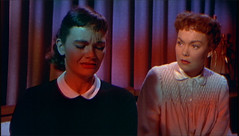
After the more chaotic party, Sirk reveals the clock again, in the full darkness of midnight. The temporal reality foreshadowed at the film's opening now takes on a deeper meaning and the interior lighting follows suit. When there are misunderstandings between Jane Wyman and her children, for example, they exist more in the shadows of the frame than in the lighted parts. It is interesting to note that that particular phenomenon of people conversing in shadows takes place only in the house that once belonged to her and her now-dead husband. By such extension, his ghost reaches into her life as effectively as the town reaches into the main relationship. Vibrant colors and patterns of light -- especially upstairs in the more familiar, personal rooms -- further emphasizes the haunted feeling without resorting to pointing to it through dialogue or special effects.


The absolute vibrancy of such shots acts as a relief from the story's progress, even if the diversion is one from romantic conflict to mother-daughter tension. Opening up the characters' relationships, these lighting choices add a whole, new dimension to the film that may have been more flat had it not begged the audience's attention to the strangeness of these people's lives. A woman in emotional solitary confinement, a daughter who feels like she knows better than her mother and an overprotective, fickle son would have played much differently -- as if these were people we had already met and there was no real story here -- without the lighting and color choices.

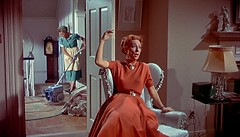
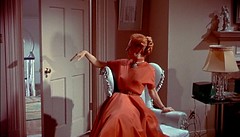
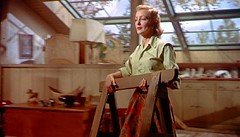
Character development especially benefits in certain areas. Consider the scene in which the busybody best friend attempts a heart-to-heart with Jane Wyman. The friend realizes that the housekeeper can hear them despite the vacuum cleaner and the action moves from this:


to this:


Although Sirk never spells it out, such actions clearly delineate the understood separation between society people and the working class in small-town America and underscores the social conflict resulting from Wyman seeing her gardener. By contrast, Rock Hudson's friends make no such separation and the audience can realize this by comparing the difference between a catered party that is already in full swing at the busybody's house and the more rustic do-it-yourself shindig that happens across town:


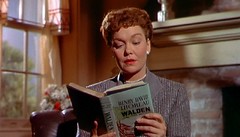
where Wyman discovers Walden:


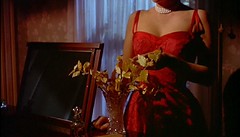
Perhaps one of the more interesting aspects of All That Heaven Allows is the museum-like quality of much of the setting. Exteriors reveal a very New England-looking autumn, but interiors often appear very serene, with a sense of almost sterile grace. The cold, damp grey of the old mill -- which Wyman prefers to the dowdier yet cozier house Hudson sleeps in -- would be uninviting were it not for the fireplace and the view. Sirk even uses framing to depict a sense of artistic stasis, exampled by this shot in which Wyman looks more like a bust on display than a woman about to go somewhere:


Such images are beautiful and haunting, with an organic quality between them, including a reference to the dead father's trophy on the mantelpiece that appears in a later visual reference on the patio at the party when a neighbor attempts to kiss Jane Wyman. [1] The reference is book-ended by the son's later protests against Rock Hudson marrying into the family, during which he brings up the trophy again, none the wiser that were Wyman to marry a man more acceptable to him and their society friends that she would be reduced to little more than the trophy that she sees reflected in the TV set the children buy her as a consolation to her widowhood. In that moment, the denouement is complete as Wyman realizes the falsity and emptiness of the life that stretches before her if she continues to care what other people think of her.

Although Sirk's approach is more subtle and perhaps craftier than Ford's, each film still exists within the framework afforded it. The distractions that occur within each film serve purposes in conjunction with -- and not contrary to -- the films' best interests. The singing Apache woman may seem at first like a considerable and even jumpy digression from the film's internal movement toward peaceable relations and certainly from its explicit movement toward the end of the coach ride, but it acts as cover for horse thieves to get away, distracting both the audience and the on-screen characters at once through unexpected entertainment. The early, somewhat shocking medium shot/jump cut of the banker warns the audience that something is not right without giving away an important plot point that would have detracted more from the film than the shot does had it been gleaned early.

These considerations promote the pleasure of viewing, the addition of information occurring only when necessary. Perhaps more important, though, to the filmic world is the sense that each film acknowedges that duration is short and fleeting, that the stagecoach ride can only last as long as a town or a memory's hold upon a person. In that sense, each film takes a greater place within the cinematic world, each aware of its own transience and mortality as surely as anyone who ever lived in the Old West; or anyone who has walked the streets of a small town with her thoughts miles away in Walden's Pond; or anyone who has ever noticed how silly and filmic real life can be.

[1] It is impossible for me to determine whether I would have picked this out on my own, so I must give credit where credit is due: former film blogger Andy Horbal first pointed it out in a post complete with screen grabs. Check it out.

Labels: , , ,

Sunday, February 25, 2007

Maternalism & the Female in My Favorite Wife (1940) and Meet Me in St. Louis (1944)

The following discussion is the second in a series of writings designed to broaden my filmic horizons. The first segment of this particular series looked at Modern Times as one representative of the silent film era. The focus this time around is on "classic Hollywood cinema." As defined by David Bordwell and Kristin Thompson in Film Art, classic Hollywood cinema's "conception of narrative depends on the assumption that the action will spring primarily from individual characters as causal agents" and that "the narrative centers on personal psychological causes: decisions, choices, and traits of character." [1] A character has a desire, there's some sort of goal; but, naturally, a counterforce always lies in waits to foible and block the character and make him or her our hero...

In My Favorite Wife and Meet Me in St. Louis the female characters possess what might be considered an unusual amount of strength given the time. Ellen Wagstaff Arden and Esther Smith each exude a strong maternal affection so naturally that it appears to be a given of a desirable woman of the day. Contextual cues also serve to negotiate these gender roles in a way indicative of the call for women, as Lynn Spigel observed, "by popular media to enter traditionally male occupations during the war." [2] Both Mrs. Arden and Ms. Smith were designed to appeal to women of the same class in an adventurousness that still allows room for the boy next door but not without some remediation. The way in each film approaches that design, however, varies considerably as will be seen.

A revisitation of the on-screen charisma exhibited by Cary Grant and Irene Dunne in The Awful Truth (1937) presents the audience yet again with two protagonists. When Ellen Arden turns out not to be dead and lost at sea, the recently remarried Nick Arden finds himself flummoxed and unsure what to do. While Ellen desires to have her husband and her family back, Nick's character holds the flaw that must be ground down and polished: wishy-washiness. By disguising Ellen as the antagonist to Nick's desire to have everything turn out well for everybody (without having to make any decisions), the writers (McCarey, Spewack, McClain and Kanin) reinforce the image of an ideal wife and mother who is essentially perfect, capable of the same things as her male counterparts and only awaiting for her man to grow a little backbone. He must find a classy way to annul his second marriage while she must find a way to re-enter the lives of her husband and children. In order to establish a sense of balance another man also gets thrown into the mix, someone with whom Ellen spent her years "lost at sea." By leveling the romantic playing field, the love story becomes more believable as the audience witnesses how much the idea of his wife spending seven years alone on an island with a strange man pains Nick, who subsequently all but forgets about his new bride.

While Meet Me in St. Louis uses a far more traditional context, its approach to conflict renders it unique and even strange perhaps to anyone unfamiliar with the semi-autobiographical novel by Sally Benson, upon which it is based, or the fascinating history of the city of St. Louis itself. Garland's character is the second of three older daughters hoping to marry the literal boy next door and subject ostensibly to the conflict of the Smith family's possible move to New York City for economic reasons. The move could break the tenuous love affair blossoming between Esther and John. Moods and romantic suggestions color the film through song and dance routines and that same ideal image of womanhood shines through as the men slowly but surely realize that they must speak up in order to get the girl. More importantly, Esther Smith shares an uncommon bond with an uncommon little sister whose psychological havoc with traditional gender roles scores darker notes in this otherwise light fare. While Esther dreams of first kisses and Christmas balls, Tootie executes her toy dolls stoically, even grimly, in an expression quite against the characteristic grain of the future mother, housekeeper or matriarch.

Most interestingly, nobody notices these odd quirks of the youngest daughter's nature, not even in a house with little breathing room and close female relationships. In this way, Tootie's actions symbolize a definite, closeted change in gender roles with a cloudy and indefinite future--a threat to the film's ideology as identified by Bordwell and Thompson. "...Meet Me in St. Louis, like most Hollywood films, seeks to uphold what are conceived as characteristically American values of family unity and life." Pointing out that the film's motif is one of static preservation, they further note that that "the home appears to be a self-sufficient place; other social institutions become peripheral, even threatening." It is also interesting to note that these acts on Tootie's part represent a deep unrest and a rift between the women of the family, a direct result of the external forces at play because of males actions--or inaction. While the outside world prepares for the advent of the 1904 World's Fair (i.e., the Louisiana Purchase Exposition) and horse-drawn carriages give the right of way to motorized vehicles, inside the Smith home "...women are portrayed as the agents of stability. The action in the story constantly returns to the kitchen, where Mrs. Smith and the maid, Katie, work calmly in the midst of small crises. The men present the threat to the family's unity."


Each of these films employ a mixture of perceptual and mental subjectivity. After witnessing the physical prowess of the man with which his wife lived on an island, Nick Arden's mental torture manifests itself in a hallucinatory image at once funny and indicative of his state of mind. Many of Minnelli's musical numbers could be construed as mental subjectivity as the audience listens to Esther's thoughts and ruminations through song. It might be said that while Meet Me in St. Louis relies heavily on mental subjectivity and My Favorite Wife upon perceptual subjectivity that each operate differently within their largely omniscient point of view. The audience almost always knows more than the Ardens at any given time, which is just part of the fun, but these two characters catch up on the facts as the story unfolds. The Smith sisters and their family and beaus are considerably more vague; the audience sees into each private life, but the web never quite connects on the screen. If the audience only considers the desires of Esther, though, the narration then becomes more restricted to her character's viewpoint, waiting with her to see if John Truett will make up his mind and things will work out somewhere between St. Louis and New York. In this sense, the omniscient view point reinforces the use of each character in its distinct position within the framework of the film's ideology and ostensible recipe for romance.

"Straight musicals," Bordwell and Thompson write of films like Meet Me in St. Louis, "are often romantic comedies, in which characters typically trace the progress of their courtship by breaking into song to express their fears, longings, and joys." Bordwell and Thomspon also note the connection between musicals and children's fare, a decidedly good point looking at Minnelli's film as a whole. Not only do children appear in the film prominently, but the recurrent idea of resistance to change conjures a romantic perception of childhood innocence and youth in general as something to be preserved and cherished lest it be lost forever. It often feels that musicals and love stories go so hand-in-hand because of the imperfect nature of words when trying to express strong feelings. Actions always speak louder than words, but what satisfaction can an audience derive from a love story in which no words connoting love or intimacy are exchanged? By the same token musicals provide more than a means to that expression; they also allow for intrigue between the characters to build as the audience becomes ever more privy to the character's desires and ever more aware of the growing love interest's ignorance. This romantic plot line insinuates itself naturally into the musical form--even when dealing with supposedly revolutionary characters in Hair (1979) or a platonic historical figure in Jesus Christ Superstar (1973) or a desperate and ultimately doomed love affair the likes of Moulin Rouge! (2001).

Bereft of musical numbers, romantic comedies--particularly the "screwball" comedy--employ more plot twists and devices to keep the audience intrigued. In order for a love story to be believable, both parties (according to Hollywood) must hold more than a passing interest in each other; they must each at least try to make the relationship work, even if only the audience can fully appreciate their attempts. Or, to quote the authors yet again, "The screwball comedy traditionally sets up a thematic opposition between a stiff, unyielding social milieu and characters' urges for freedom and innocent zaniness." The judge in the courtroom represents the law and authority and an indifference to the qualities that make this romance work--love, forgiveness and spontaneity--a recurring obstacle in comedies from His Girl Friday (1940) to Some Like it Hot (1959). The use of certain Foley sounds, such as pings that sound when something racy has been implied, also seem to be the sole province of the screwball comedy; and, unlike the musical genre, the story determines the film's general reception as the audience relies more on the character's interaction rather than their ability to emote through song and dance routines.

To return to Spigel's words concerning the changing gender roles in World War II's America for a moment, it seems a good bet that a lot of the dialogue in My Favorite Wife was crafted with that shift in mind. The judge/authority figure frowns upon Ellen Arden's role, but is more confused than condemning. She retains her maiden name (Ellen Wagstaff Arden) perhaps as part of her role as a former Southern belle, but probably also symptomatically of a new way of viewing the woman's role in a marriage. Her role as a mother demonstrates itself as an egalitarian negotiation between her and her husband that keeps what's best for the children in mind but does not usurp the romantic ideal of being a woman first and a mother second--despite the twin beds in the marital chamber. [3] In other words, explicitly a woman has to grapple with her various roles but implicitly a woman's strength of reason and resolve create a home in which a man can either snuggle up or leave to find a new mate. In contrast, the maternal strength in Meet Me in St. Louis manifests itself much differently. If the outside forces of the world--a world run by men--present a threat to that strength, the period piece musical acquires a new dimension non-existent in the screwball comedy, a defiance of a perceived societal shift. Where the screwball comedy interacts with that shift, the musical seeks to trap and distill it--crystallize it--and let the world see what it is that they will be forever missing.

[1] Bordwell, David and Kristin Thompson. Film Art: An Introduction. Eighth Ed. McGraw Hill: University of Wisconsin. 2006.

[2] Spigel, Lynn. Make Room for TV: Television and the Family Ideal in Postwar America. The University of Chicago Press: 1992. (All excerpts Chapter 2: Television in the Family Circle)

[3] This ideal female image would re-prioritize those roles in the post-war era. Spigel discusses the reaction to the undermining of the male's assumed authority in the household and workplace thus: "...women were given a highly constraining solution to the changing roles of gender and sexual identity...Marynia Farnham and Ferdinand Lundberg's The Modern Woman: The Lost Sex (1947) gave professional, psychological status to the housewife image, claiming that the essential function of women was that of caretaker, mother, and sexual partner. Those women who took paid employment in the outside world would defy the natural order of things and become neurotics...The domestic woman needed to save her energy for housekeeping, childrearing, and an active (monagamous) sex life with her husband."

Labels: , , ,

Wednesday, February 14, 2007

Love & Loss, Jane Campion-Style

While airing the old gray matter, trying to recall good love stories written and directed by women for the Lovesick Blogathan, I came across many that could have made for a post rivaling Yonge Street and the Nile in length. Rather than digress upon all of these terrific films, which included Randa Haines' Children of a Lesser God (1986), Sally Potter's Yes (2005) and even unheard-of Canadian director Holly Dale's little-known Blood & Donuts (1995), it seems the smarter idea to tap the one recurring theme that nearly all of these films had, especially the better ones, and try and talk about that instead. Understanding that conflict is vital to almost all writing involving human interaction, it feels a natural course to discover that some major dynamic hurdle exists in these writings on love. Sacrifice, pain and loss seem to be the staples of the humble pie that often accompanies affairs of the heart. Whether at the beginning or at the end or somewhere along the way, it's almost necessary to the real fulfillment of love to experience a loss of some kind. Sometimes that loss prepares Cupid's pathetic victim for what might be the best thing that ever happened to her or him...and sometimes, it sends us to a quieter stage to lie in wait for the next.

Jane Campion seems to understand a lot about love and its partnership with loss and she has a special talent for really peeling away the layers of familial relations to augment the rawness and scariness, the abject loneliness, that can surround and even overwhelm two people who are trying to make a go of it. She did that jarringly, but wonderfully in Sweetie (1989), about (among other things) a woman afraid of trees who co-plants an alder sapling with her new sweetheart as a metaphor for their relationship, and then promptly steals the tree, hides it and pretends to know nothing about the event whatsoever despite the angst it causes her lover . In 1993's more celebrated work The Piano, she takes the idea of loss and gives it a new path that practically begs for close inspection. The technical challenge alone of writing for a heroine who speaks only through a musical instrument -- and by choice -- comes off at first not like a loss, but a study in stubborness, the brand of which can certainly be found among the women embracing the shores of a former penal colony, if it can be found anywhere. That underlying sense of pioneering background colors this work perhaps most of all, imbuing the main character with real spark, but also perhaps alienating some who simply wish to find the love story between Ada (Hunter) and George Baines (Harvey Keitel) tender, romantic and passionate.

Campion uses the film's New Zealand setting well. By opening and ending on the beach upon which Ada's piano is deposited and left to soak in ocean spray, she hinges the entire story upon a place where change is constant, where give and take simply exist. Within the first few minutes, underscored by surf, we are invited to understand the depth of Ada's inner struggle. Her father has sold her in marriage to the Reverend Alisdair Stewart; her very entrance is a glum and unflattering sacrifice. She raises a daughter from a previous marriage, a constant and lonely reminder of her past. When her new husband won't allow the piano to weigh down their caravan, small notepad and sign language between Ada and Flora aside, she loses her voice. Physically, she could speak, yes, but as she tells us right from the start, she has not since she was six or seven and even she does not know why. In a world of films which seem to lean upon the convention of men figuring women out, the admission that a woman can be a perplexing mystery to herself is more than just a departure from the norm. That tiny detail allows us to explore Ada's love affair with life through her piano as true seers, not knowing any more or less than she does at any given moment. We hear only the piano notes and this very fleeting voice that sounds like writing in a journal.

Perhaps because vocal communication can be such a frustratingly limited means of expressing ourselves and making ourselves understood and known to each other, the centrifugal force of Campion's story does most of the work for her. Her husband and his friend are each curious about her in different ways. The former, wishing his wife to like him, attempts to appease her; but George Baines -- the more relaxed man who spends more time among the Maoris than the whiter folks -- wishes her to love him. In an unlikely trade, Baines becomes the proprietor of the piano in order to receive "lessons" and before long is trading romantic gestures for Ada's increasingly clandestine visits. Love has become a negotiation.

(...a very intense and erotic negotiation performed by textured compositions and a terrific full-nude shot of Harvey Keitel that I've never been convinced didn't help Hunter win the Oscar*, despite her apparent talents.)

Yet despite all of this hardship and loss -- a basic disrespect for a property that means much to Ada, far beyond the value of its ebony and ivory -- Campion also seems to be saying that people who have no way of communicating and who may not even know about love from lack of experience can find true happiness under even the most grotesque or bizarre of circumstances. Witness when the good Reverend cuts off Ada's finger in a fit of jealous rage, an attempt to wound the part of her that makes love to his indifferent neighbor so effortlessly, using only a housing of wood and some string. It feels like he provides the fulfillment of Ada and George's love in many ways by severing her finger. That violent culmination of a life spent in silence doesn't force Ada to shout out like you might expect it to, but to gather herself in a new way with a fresh outlook.

Were I to discover that I had the love of a man like George Baines, I'd be willing to lose a finger to that end, too.


*Probably one of the best examples among Oscar moments regarding the magic of film and the suspension of disbelief. We all love Holly Hunter, even those who could do without most of her films, but when she spoke in that lovely cagey drawl of hers to accept the award, The Piano lost a bit of its charm.

Labels: , , ,

Sunday, February 11, 2007

El Laberinto del Fauno (2006)


Dir/Writ. Guillermo del Toro
w/ Ariadna Gil, Ivana Baquero, Sergi López, Maribel Verdú


First thing's first with a movie like Pan's Labyrinth (2006): You have to see it to believe it, and if you haven't already seen it, you'll need to remedy that as soon as possible.

It's very hard to go wrong when Alfonso Cuarón is involved with a project, but Guillermo del Toro (who directed this particular project) goes the extra mile to ensure that from beginning to end it is a work of integrity worthy of the passions and innocence of youth, the foibles of tyranny and the eternal struggle to find something pure and safe and lasting.

In short, he has created a classic film.

Those familiar with the fantasy genre will recognize that this film lies somewhere outside of the standard categorization, both in content and in context: set up like a folk tale that could easily have been taken from For Whom the Bell Tolls, our young heroine must brave the tasks set for her by a faun of the underworld despite the brewing storm of Francisco Franco's Spain. Caught between a stepfather whose fanatic loyalty to Franco's dictatorship parallels his indifference to his new wife in everything but to produce a male heir, Ofelia must accomplish what Pan sets her to do or face the consequences of her own mortality. And when the daughter of the king of the underworld has been charged with duties to prove her identity, she must arise to the occasion.

The terrific thing about a film like this is its universal scope. At all levels, it registers with deep and hidden truths about childhood and growing up and the constancy of humanity to maintain a struggle between good and evil, despite ages of evidence arguing that we should give it up. The allegory of the labyrinth operates not in the mists, though, but in the reality of never knowing what's right around the bend. Like any good coming-of-age tale, that's the abiding rule.

Fans of the fantasy genre may need to adjust their expectations a bit. Legend, The Dark Crystal and The Lord of the Rings -- even The Chronicles of Narnia (although the PBS version of that story still carries the brass ring) -- each have their specific places in the movie-going consciousness. Even films with varying production values and themes, such as Conan the Barbarian, Conan the Destroyer, Red Sonja, Krull and Clash of the Titans can say roughly the same thing. This film, imbued with life by incredible writing prowess and a childlike savvy, leaves the clichés and typicalities to the past, beating a new path for the international scene.

And while one well-made film's not enough to go on -- to get your hopes up that this will start a cultural revolution -- it's still some pretty exciting stuff.

Labels: , ,

Sunday, January 28, 2007

Volver (2006)


Going to see a Pedro Almodóvar film is a lot like taking a ride on a metal roller-coaster. Unlike the primitive wooden ones, you can relax knowing that you're not going to get jerked around a lot while watching the rush of pretty colors and participating in the squeals of delight. Right from the get-go, the characters are in the middle of their lives and you get to watch them sizzle and spark and diffuse the screen with everyday moments that could easily have been you only an hour ago. One of the best treats of the Spanish director's peculiar gift -- specifically, his restraint in ladling out huge dollops of back story to queue us up to the present -- places the story in the heart, asking only for your rapt attention. He does this so well that I imagine the only better way to watch one of his films would be as a native speaker of the language.

Familiarty with Spanish customs seems an almost negligible dimension, though, so it sounds just as plausible that, other than the slight inconvenience of non-speakers having to read subtitles, his films are seamless and character-based enough that the audience loses very little by virtue of that. And that, to me, is what really makes Almodóvar stand out among his peers and predecsessors. Not many non-English speaking directors -- nor, even non-Hollywood, for that matter -- can claim the kind of fanatic love and loyalty while also reaping the benefits of a very wide audience. Indie directors would be accused of mainstreamism and many foreign film directors would be accused of a cultural watering-down of their vision.

But Almodóvar is Almodóvar, world without end, Amen. Or so it seems...

Anybody disagree or have an insight? I'd like to do something different this time, and open this up to discussion before proceeding with the usual straight-forward review.

Labels: , ,

Sunday, January 07, 2007

Temps en Je, tu, il ...elle (par Chantal Akerman)

The following entry is for the Unspoken Cinema Blogathon..

Enjoy, folks...


If you've never had the chance to experience an Akerman film, especially this one, then you have missed out on a rare chance to glimpse both a fine madness and a stark honesty about the human experience at once. Without spoiling it for anybody, the film exists in three parts defined by locale and the relationship of the character (who feels often more a subject than a person) with the viewer, the setting and the other two characters in the film -- from whom, remarkably, we derive less of the subtext than we do from the filmmaker herself in the lead role. In the first part, she exists in a room that she empties of its furniture to make larger, writing and writing a letter so rambling and long that it is to the world of love letters what Berlin Alexanderplatz is to the world of fictive film. Living on powdered sugar and clothes that are more often off her than on, we witness her unobstructed expression of the deprivation and self-isolation that love can manifest in us.

Akerman's great pains to occlude our sense of time during this first third acts as one of the great boons of contemplative cinema. In a way, it is more real than "real time" because when faced with any kind of suffering or challenge, we so often seek refuge in some amount of disorientation. At times, she narrates her own actions in the room before she has enacted them; sometimes, after. Either way, the suggestion adds a great layer to this film of feminist deconstruction, this cinematic act of contemplation. By asking us to watch and listen out of sync, the film achieves its intended effect as a piece of contemplative cinema -- or, what the natives are calling CC these days -- because, less important, her actions retain their sense of survival and grubby familiarity without overshadowing the suspension of disbelief.

Within that suspension of disbelief, the filmmaker works her magic. Her state of mind and emotions are not obvious or even alluded to; her purpose (whether for being in the room or on this earth at all) is not mentioned. What Akerman does is invite her audience to participate in the extraordinary everyday-ness of lying in a room and writing a letter. At one point, she even spreads each of the pages around as though they were index cards, using sticky putty to place them firmly on the floor in an order of rows and columns. What a commentary on human activity, on the fluid ordering of our worlds in the attempt to exert control and finiteness to life. When she finally leaves the room to venture into the second act, she hitches a ride with a trucker and makes herself a sounding board for his life's story. She doesn't speak herself. We have heard her voice only through the first-person narration of the first act, and Akerman keeps it that way.

Not until the third act, in which she arrives at the doorstep of the woman to whom she has written the letter, do we see the connection of sound to character. Many reasons pepper this procrastination, all of which could be pondered to death, but I'd like to consider -- above all else at this juncture -- the role of time. Where time was an obstacle to be subdued and imbued with persepective in the first act, it has become an obsolescence of minor detail in the second. No rush characterizes the middle act, her journey to reach her lover and glean her reaction. He talks, she listens and smiles. They stop to eat, and she eats. The journey will take as long as it takes because that is how time works, the filmmaker appears to be saying, but the contemplation has all but receded into a minority of its own. The truck driver contemplates his own life in his own words, rather differently from her.

And it is here that I can't help but observe some irony in that what is meant to serve as an aural and visual relief -- some narrative enters as they travel and reorients the viewer, and some comedy arises from this new character's monologue -- actually signals the ebbing of the contemplative life that Akerman sketched for us with such great care in the first act. His life and personality are different, true; but beyond those definitions, this truck driver lives in the now. He does not suffer, and yet the viewer feels a loss of the intimacy and true-ness his passenger provided before they met. Perhaps one of the more humorous and telling aspects of Je, tu, il ...elle, though, arrives in the third act with specific regard to time. Our character spends all this time arriving at her destination only to have to leave it again so soon. It speaks of the brevity of all such action and motivation, of the unimportance of all time -- except where it is spent in exploration of truth.

Labels: , , ,

Wednesday, December 13, 2006

Unspoken Cinema: Music & Experience as narrative force...

Anticipation of a Video Collective's Project


Yesterday evening, as part of my promise to myself to extend my visual foray into foreign lands, I ventured over to Melwood Avenue, that tiny dead-end street that only those familiar with Pittsburgh know to rest within city limits. Come to think of it, rest is a funny word, really. It sort of hunkers in the nether regions of the city, as disconnected from its "suburb" of Oakland as it is from the greater Three Rivers area. You know that alley that doesn't go anywhere in that B horror film with the zombies and the sunglasses and the shopping? Existentially speaking, that's where Filmmakers crouches on the psychic map -- disintegrating curbs, fire hydrants and all.

I parked my car as I used to do routinely only a few years ago and prepared myself for an evening of short videos collected by a hodge-podge of local filmmaking hopefuls who had gathered in the even seamier suburb of Braddock under the banner Film Frenzy. The spearheaders of the grassroots co-op wish to see the thing take off in a not-yet-envisioned way that lends itself to collaboration in a way not-yet-defined; and, you can read more about the specifics of their overall vagueness in Bill O'Driscoll's write-up on it in last week's City Paper. Although somewhat more like an exercise, the idea held enough interest -- at least in terms of what young people are doing with and thinking about video these days -- that I'd decided I could spare the scant dollars and even looked forward to the event despite my disconnection with a school I had once had great hopes for, but with which I so quickly became disenchanted.

[Yes, intrepid, self-sacrificing supporter of the arts...that's me. Plus, I had a ton of work which I decided I wouldn't get to after pacing between my kitchen and living room for half an hour.]

Although I was certain I was right on time, projection had already begun when I found the room. I walked to the nearest easy-on-the-neck seat, well in front of the majority of the sparse audience, and contritely breathed silently and stayed still. Within seconds, the fellow sitting a half a row down in the same row began clicking his pen. The room was quite dark and I could not actually see him, but the way he clicked the pen decidedly made him a man. Don't ask me how I knew this...I just did. The remainder of the evening's proceedings will be an alternating dialogue of my impressions of the film in plain type and my italicized impressions surrounding the man who -- to aid you visually as you read -- looked a hell of a lot like Sideshow Bob, but in dockers and tweed, and sporting more neurotic ticks than just pen-clicking.


Audience as Interaction in Non-Narrative Film


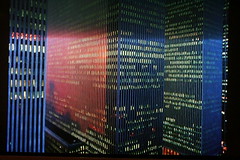
The screen to which I am first introduced is filled with somber but hopeful cityscapes in which buildings shape unique corridors and reflect time-lapsed skies. It reminds me a great deal of the architecture photographs used to advertise Filmmakers at local theatres like the Waterworks in the good old days, before advertising became the mainstay of pre-movie watching and waiting. As someone who considers movie theatres to be her only church, I have often thought of that ten to twenty minutes before a show as meditation time in which to sip coffee and reflect on all the events of a week which conspired together to bring me to that particular moment. Such meditations have a naturally soothing and invigorating effect that put me in the right frame of mind to not only watch the film but to tune out nearly everyone around me. Pleasant stuff.

Seeing something that reminded me of cinematic life before "the Reel thing" put a smile on my face. The smile lingered; the reverie vanished almost instantly. A fairly steady stream of collaged images began to take on uniformity and compression. Rows of brownstone filmed from the back revealed unending lines of windows, fire escapes and framework, all alike, all static.

Click, click. Why is he looking at me? This is fascinating.

Click.

The camera traveled over unidentifiable rubble -- decomposed building materials, presumably -- to expose the parts of urban life most cameras avoid in the U.S. The pictures look like shots from third-world countries, and the sight of the indistinguishable architecture of unidentifiable metropolitan area after metropolitan area turns oppressive.

Dresden. This looks like what the government tried to do in Dresden after the war. It's not a suburb, and these aren't developments, but this is the imposition of uniformity upon a society.

Click.

My society. Not that it matters, but where the hell is this? Click, click.


Buildings start imploding, and it occurs to me for the first time that the "Film Frenzy" folks have really outdone themselves. I begin to wonder, as the implosions become more elaborate -- high rises set in difficult nooks between vulnerable buildings, and even a bridge -- if what I'm actually seeing is stock footage. If it is, I want to know where they got it from because it's not just that this isn't Braddock. It's beautiful -- and not just the capturing of these moments because, by themselves, I wouldn't think much of the shots. The compositions lack judgment, creating a somewhat pretentious neutrality; the juxtaposition of the framing with the score, though, strikes whole sets of emotions in the viewer. Instructive musical composition, if you will, sears these images of destruction with an acute sense of medieval-like exuberance. The oppression, like the Dark Ages, can not go on forever, it sings. These buildings must fall, were meant to fall.

Within moments, people on the sidewalk are incorporated into the collage matrix.

They're all wearing heavy, starched polyester.

Any suspension of disbelief that this could have been shot in the digital age corrects itself, and I look more closely at the blurriness and decide the film was probably shot on 16 mm. It's still quite blurry in places on purpose, but occasionally even the diminished screen gives itself away.

Click, click. Legal pad page turning. Hmmm...I'm guessing that this isn't a Film Frenzy production after all. This must be the opening act. Hell of an opening act. Click. I wonder if he's upset because I got here late or because I haven't paid yet. Hmm...

The filmmaker -- who I find out later is Geoffrey Reggio -- recreates the concept of mass movement over and over again with Ron Fricke's incredible cinematography. Some of the shots are just generally blurry and planeless. People pass by in slow motion impressions of themselves. They fast forward up escalators and through fast food meals in waiting stations, giving away their nervousness and inability to stay still even when talking to each other, eating or simply watching the masses of people around them. The camera plays with both fast and slow motion in such a way that the lives of the people, the character of the people and any other identifiers that mark them as humans who interact in any way besides movement gets stripped away. These aren't people at all, throughout most of the film. They are predictable, unstoppable vectors that have no destinations, no motivations, only kinetic reality.

Fricke soon switches to fixed focal plane shots on the sidewalks, and faces come into sharp relief for a moment before stepping back into anonymity. As the film moves into an area that I realize was once considered to be visually stunning, I recall a lot of the photography work I used to study, as gathered by John Hedgecoe in The Photographer's Handbook. Instead of opening the shutter to allow car lights to blur, though, the film camera uses time-lapse and more sped-up footage to show the traffic patterns at night, the infrastructure coilings. All the while, the music cues and instructs the facial muscles and other various pressure points. I should have realized why at the time, but it has been too long since I listened to Philip Glass, and I must admit that I don't speak a word of the Native American Hopi language.

In case you haven't guessed it by now, the film I am watching turns out to be Koyaanisqatsi (1982), nine years in the making and the first of what Reggio is still finishing: a trilogy of collage films. His subsequent film, Powaqqatsi (1988), was much less well-received, and he is currently working on Naqoyqatsi. To curtail my brief effort to encourage viewership of at least the first film, I'll mention what Reggio's short bio (linked above) does not: he was disrobed in 1968 by the Roman Catholic Church for what Ephraim Katz cites as "ideological insubordination" in The Film Encyclopedia. As should be expected from someone so outcast from the mainstream, each of his films hinges upon a central theme: life out of balance, life in transformation and life as war, in respective chronological order.


Many frames in the film held powerful symbolism.


Some moments were so hard to handle that at one point in the film, I only stayed for the credits. It's not my style to walk out of a movie that I know to be well made, even when I find its study of dehumanization to be overwhelming. I just don't like pain that much. But I was glad that I stayed. At the end, after the oppressive images finally ended, after the last person on the street who obviously didn't want to be filmed and leered at the camera with suspicion and hostility, the camera focused on an ancient Native American sketch and informed the viewer of the word which had been sung repeatedly in Gregorian-style chants a la Glass' cruel conductor's wand:

Koyaanisqatsi, a Hopi word meaning 1. crazy life, 2. life in turmoil, 3. life disintegrating, 4. life out of balance, 5. a state of life that calls for another way of living.

The lights come up to reveal this jittery filmmaking instructor and a scant class that I did not turn around to viddy. He looked at me but once or twice as he talked about how he hoped that everyone had gotten something out of the film, and that it should give them a fairly solid idea of what film -- although undeniably containing a point -- without narrative does, letting the story happen in the viewer's mind to a great extent, etc. He points to the dehumanization of mass culture and to the textual shots of the people on the street, noting that these cuts have interfered somehow with these people's lives, and that we see the frays.

He's obviously very disappointed that his class isn't engaging him in conversation about it, and he's nervous about that, too, and my heart goes out to him. And then his cell phone goes off. He's got one of those nature sounds instead of a digital tonal, and one of the class members snickers. It recalls all the reasons I don't miss being a student at Filmmakers. I prefer wide open spaces and quiet repose and, failing that, I'll take my modest apartment and a cup of tea.

...All of which is a polite euphemism for I'm too old for these reindeer games.

When it becomes excruciatingly clear that his students have nothing to say, I stand up and apologize for crashing his class and tell (lie to) him that I had gotten bad directions. This was the mini screening room. I had wanted the other one. I also tell him that this was probably a much better viewing than I could have hoped for that night, and thanked him. He seemed relieved, and told me that he was glad I had gotten something out of it.

Indeed I did, Sideshow Bob. Indeed I did.


Conceptual Conflicts in Non-Narrative:

Music & Expectation


Two major factors arise as I consider the open-ended qualities of a non-narrative film like Koyaanisqatsi. The first is the addition of musical score. Whether the score acts as a driving force to the film's visual composition or as a counterpoint to the visual workings, the score instructs the viewer in ways less open-ended than the visual text. Tensions resulting from internal and external rhythms, reliefs provided by harmonies and dynamics of tone and pitch all provide rich and complex texts of their own. While this may seem like a passé reiteration for a study of "contemplative cinema," the fact remains that films like Koyaanisqatsi have been and still are considered to be non-narrative film despite their heavy reliance upon an inherently narrative-producing medium engulfing an entire realm of scholarship and technique all its own.


The second major factor I see as inherent in the non-narrative experience remains the consistent human expectation of story-telling in art forms. Because it is a natural and fundamental human process to relate through narrative, when we are approached by and engaged with an art form that purports to (or that scholars identify as) being non-judgmental and solely experiential that an audience will inevitably -- as a collective or individually -- try to arrange the film as a narrative to make sense of it. In and of itself, this process feels right, but it also trends toward a deeper aspect of human narrative expectations; i.e., because the director has selected material and arranged it in a certain way, the audience will not be satisfied with a narrative structure that is arrived at solely through experience, but seek to determine the author's intent, the author's point of view and what the author is trying to say.

The very act of experiential non-narrative viewing, in this sense, has the ability to negate the wishes and efforts of the director to create a freely interpreted form as the audience seeks to find the narrative through the film's various elements -- both what's used, and what is not.

Labels: , , ,

Thursday, October 26, 2006

Flags of Our Fathers (2006)


Dir. Clint Eastwood
Writ. Paul Haggis; James Bradley, novel
w/ Ryan Phillippe, Jesse Bradford, Adam Beach, Barry Pepper

In a breath-taking reinvention of the war film, Clint Eastwood’s Flags of Our Fathers depicts the less visible elements behind war through the experiences of three seeming heroes. Ryan Phillipe, Jesse Bradford, and Adam Beach re-enact the masquerade three soldiers are asked to perform after a prematurely victorious claiming of Iwo Jima ends with bloodshed. The snapshot of the event is sent back to the States for mass production where it becomes iconic overnight, spawning a false sense of closure. The shift in public perception as a result of the now-famous image tells the story of a war that bankrupted the treasury, forced the FDR administration to inflate the economy with freshly minted money, and brought three soldiers home to sell war bonds vis-à-vis their new glory.

Half-truths are the stuff of wars and Flags breaks no knuckles to dissemble that fact. The lies revolving around the three soldiers’ tour bear the burden of the story’s larger context, the reflection of war’s presumptive deceit. Emotions brought to heel by the scope of what each soldier has been through acts as the focal point for the film’s inter-cutting between the trenches of Iwo Jima and the anti-climactic stadium tours for the American public. Embodying the more frenetic emotions is Beach as the real-life Native American soldier Ira Hayes, who had wanted to stay on the front but gets shipped home for the war effort instead. Getting drunk night after night, Hayes spills their general reception to the horrors of public ignorance as much as, if not more than, the horrors of war.

And horror, precisely, informs Eastwood’s landscape, not action. By taking the verbal subtext of the standard war film format out, and replacing it with a suspenseful sense of the macabre, he has isolated war as singular acts and experiences with repercussions on a personal level that may not have been visually discussed before Flags. Soldiers crouch in pockets separated from their fellows with darkness, smoke, and distance. Guns emerge from Japanese turrets with painstaking separation from their unseen operators whose aim is uncertain but a sure and calculated defense against an overwhelming invading force.

That Eastwood never stoops to overwhelm with sheer numbers in battle, nor with epic CGI landscapes, credits the director’s intent and casts a quiet, new light on an already impressive and understated filmography. That’s not to say that Flags doesn’t employ effects where needed, nor that they aren’t magnificent when applied; but the focus remains on the inner turmoil and its translation to the audience member as a participant in a war that pulled attention in so many directions, in part to avoid facing the grim truth and the grimmer realities of World War II. America and the world have seen the bloody combat scenes time and time again in war films. Eastwood lays those impulses aside to set the tone and the space to go someplace new, unexplored, and ultimately languageless.

That undiscovered country will emerge of course in his follow-up segment, Letters from Iwo Jima, which will appear early next year from the Japanese viewpoint. A decidedly good and fresh idea, the echoes of the first installment should still be sounding softly by that time, a reminder that a new outlook on an old and still unresolved problem always exists in the eyes of the searching. My gut tells me that Letters should bring that home.

Labels: ,

Sunday, September 24, 2006

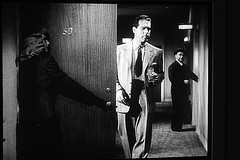
Double Indemnity (1944)


Dir. Billy Wilder
Writ. Billy Wilder, Raymond Chandler; based on James M. Cain's novel
w/ Fred MacMurray, Barbara Stanwyck, Edward G. Robinson, and Jean Heather

Trying to reconcile himself to the person he's closest to, insurance salesman Walter Neff surrendurs the truth of the events leading up to a fraudulent scam in which his lover's husband can produce a golden egg by dying accidentally on a train. The voice over narrative, ever reminiscent of the opening scene of Neff careening recklessly to get to the office, leads a suspensful and introspective domestic nightmare. As he's pulled ever deeper into Phyllis Dietrichson's machinations -- sympathizing with her dread of the abusive, alcoholic terror awaiting her at home -- he learns that all is not as it seems. Their lopsided love affair staggers between the twisted passion that arises at the prospect of ridding the world of one man and the thrill of plotting a scheme that would go all the way, no hiccups, straight down the line.

If ever a writing duo wove an unsung swan song, Raymond Chandler and Billy Wilder did when they penned this lush but terse and often powerful landmark film. [1] Although owing a lot to earlier noir-like flourishes, Double Indemnity remains an enigmatic foreshadowing of the subsequent emergence of American crime novel fixation in Europe, and film historians usually diagnose this as the first complete noir expression. [2]

All the elements of classic filmmaking, though, combine to render an intriguing and unparalleled feature that bears, as part of the ironic legacy of its title, the dual blessing and curse of reflexive history. In response to its less than immaculate reception at the Academy, Wilder sank his disappointment into his follow-up, The Lost Weekend (1945), which snagged the same majors as rival Leo McCarey for Going My Way (1944). Wilder's competitive nature probably explains most of the seeming jest of experiencing a sense of personal failure for not having made it big at the Oscars, even in light of the fact that until the 1960s, the Academy Awards were considered by more than just the Hollywood sector of the industry to be the last word in quality. Taking in the film as a whole, however, leaves a question as to what kind of director couldn't simply take pride in his work, award winner or not.

For one thing, Fred MacMurray turns in a to-the-letter performance as the salesman taking the irresistable challenge of the ultimate sale, kindling his obsession with perfection. Barbara Stanwyck, burdened with the necessity of playing off not only her co-star but the voice over, radiates an alternating little girlishness and an older woman's aloof but accessible charm. The combination's heady and alluring and wouldn't be equaled again until Mike Nichols's The Graduate (1967). But Edward G. Robinson's little man, Barton Keyes, brings a character to the screen so rich with nuance and mannerisms that his naturality as the anchor of this small insurance world oftentimes goes completely unnoticed. It's as if the sun may rise and set elsewhere, but in the black and white world of eternal noir night, the bottom line sets the bar.

To counteract that direction and to give the film a bit more breadth, perhaps, we're introduced to a fourth character, Lola, Phyllis's step-daughter. She brings back some of the daylight and a naive quality that leaves her fragile and confused, only the appropriate reaction to the world spinning out of control around her. Descriptions of sensory influences blend with Lola's simple presence in the film as a reminder of everything that the insurance business purports to protect but instead betrays.

It's so easy to be debauched by Phyllis and Walter's seductive relationship that it's even easier to forget their penchant for murder, thanks to the incredible work of cinematographer John Seitz and the chemistry between MacMurray and Stanwyck. Every gesture, every glance, charges the air around them with intrigue and excitement so compelling that even the smallest objects around them transform into conduits for those feelings. The stacks of canned goods on the grocer's rationed shelves become Aztec cities; the phone booth transcends its geography to suggest howling winds that must be hushed into reverence; and honeysuckle smells famously like murder.

The most awing and humbling act arrives when, having been caught up in the dirty business of covering up their crimes, Neff does his best to make things right. He may be a little late, but after all the madcap racing around, his effort speaks quietly of a man who recalls that life offers more than the option between the grind or a heist. Partly due to Lola but mainly because no man likes to be tricked by someone he cares about, the film's finale reverberates with the simple reminder of things that all of us need to be able to count on but can take for granted way too much. Even those not easily succumbing to the thoughtless whispers of a dark and dreary night in nowhere.


[1] Crime novelist Raymond Chandler wrote the screenplay for Alfred Hitchcock's Strangers on a Train (1951) in addition to whipping up the dialogue with Wilder from Cain's novel, which was originally entitled Double Indemnity in Three of a Kind. If titles are any indication whatsoever of writing abilities, suffice to say it's a good bet that the film's substantially better.

[2] A year too late to make the grade, Edgar G. Ulmer's Detour (1945) struck a similar note as a classic that would be all but forgotten upon release, only to be dug up by film historians who, presumably, preferred the indie director to Wilder.

Labels: , , ,

Friday, September 15, 2006

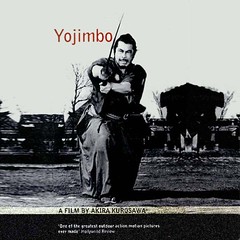
Yojimbo (1961)


Dir. Akira Kurosawa
Writ. Ryuzo Kikushima, Akira Kurosawa
w/ Tohiro Mifune, Tatsuya Nakadai


A samurai was many things in his lifetime: a protector of the realm, a defender of the ruling party, and the iconoclast to whom all other classes gave honor. In Yojimbo, he's also the scruffy wanderer who seeks to find a new place in which to sharpen his skills before they rust, and to do so with as much tact as possible. When Sanjuro walks into a town which has been taken over by a sake dealer named Seibei and a silk dealer named Ushi-Tora, he finds just such the whetting stone for his talents. The merchants, appraising the recent fall of Japan's last dynasty as a time for greed and corruption, have been busy raising their stations by collecting gamblers as cutthroat bodyguards and attacking the farmers who once supplied their trade. Although the samurai has been bereft of food and away from the ruling family he once protected with his life for an unsubstantiated amount of time, he takes his time, sizing up the atmosphere and events carefully. It is a new Japan. One of the merchants has kidnapped a local farmer's attractive wife to negotiate for his son; but, it is a time of social disorder and chaos. It is a time when some parents advise their son to kill to win the respect of men while yet others advise staying on the farm and reaping an honest day's work.

Eh, parental expectations can be heavy, you know?


Samurai as Loner: a Study in Contradiction

Humility comingles with self-sufficience in the lonely, wayward manifestation of Tohiro Mifune's chest-scratching, abrasive Sanjuro. His very name, pulled from the mulberry fields that are the conspicuous focus of his enigmatic stare, elicits a sense of dissipatory elusiveness that supercedes all of his actions. When he lets the stick fall where it will and follows, he acknowledges that his destiny lies outside of his hands. Like the restless, roving, and ultimately crumbling samurai class to which he belongs, though, this unforgettable visual component acts as deft commentary on the unforeseeable -- but just as precarious -- future of Japan.

Keiko I. McDonald's extensive look at the historically-based but aesthetically licensed milieu Kurosawa creates in Yojimbo explains the four-tiered class system as having the samurai at the top, followed by the farmer, with the artisan and the merchant comprising the bottom, respectively. [1] Having been abandoned by the Tokugawa Shogunate's corruption and collapse, the classes have been left in the rapacious lurch of the feudal system, Sanjuro included. "Kurosawa's camera, focusing on the protagonist's back for an unusually long time, evokes a sense of claustrophobia," writes McDonald. "At the same time the white family crest in the center of Sanjuro's black kimono becomes fixed in our minds." Even freed from his masters, this suggests that the samurai was still burdened with the honor expected from one of his ilk though it fails to benefit him in any tangible way. Alone, hungry, and unemployed, he moves on.

The town he arrives in has been overrun by merchant-class opportunists -- a sake dealer and a silk dealer who have each conspired with gamblers in an effort to amass muscle power and outdo the other. Ever aloof to those he claims to despise as weak and defenseless, Sanjuro appears to play heartless games of mischief as he sets the merchants and their men against each other. The open conflict this generates between the two factions acts as representative of the hard realities of that time. Despite his outward enjoyment of the goings-on, though, his alternate side emerges to reveal the inner hero. Tough love is deeply ingrained in his bluff sense of altruism, and deep down he's a role model as well as the protector of an abandoned people he loves.


Samurai as Mediator: the Strategist vs. the Humanitarian

Perhaps the most curious aspect of Yojimbo, Kurosawa's carefully constructed removal of Sanjuro from the story's more criminal elements, deters the audience from seeing the samurai too closely, nor too disjointedly. Effectually, the audience sees much through his eyes while still being allowed the advantage of telling camera work that plays all over Mifune's physique. In a studied scene in which he learns all about the town and its oily operations, Sanjuro and the old man who feeds him pace around the interior of a hut in the foreground while the middle ground remains largely empty of action and seemingly devoid of life. In the back ground, in deep focus and employing a playful Japanese sense of mise-en-scène, the merchants' men grease the official inspector's palms with money and flood his tea cup with sake. "In this town, I'll get paid for killing," Sanjuro ruminates as he watches these subtle announcements of the deterioration of his culture, "and this town is full of men who are better off dead."

Yet, Sanjuro still finds humor in the buying-off of the officials; it's the deeper aspects of cultural erosion that trouble him. The silk merchant's prayer chanting for the death of the sake merchant denotes the perversion of religion. McDonald's observation succinctly grasps the tension of these scenes: "As the coffin maker's hammer and the silk merchant's prayer drum beat together on the sound track, we realize that religion, traditionally the answer to death, is no longer an answer or a solace; that, ironically, death is the 'answer' to 'religion.'" The palpitations of the steady march of time in an era of decline reverberate throughout Yojimbo's stark landscape, signalling a sort of death pall that Roger Ebert summed up well when he wrote, "Shutters, sliding doors and foreground objects bring events into view and then obscure them, and we get a sense of the town as a collection of fearful eyes granted an uncertain view of certain danger." [2] As the audience, perhaps, we are immune to that fear; it has, though, at very least become a tangible and calculable presence among the marginalized and deserted townsfolk.

Further exacerbating the face of death in isolation is the dual irony presented by Sanjuro auctioning off his services as bodyguard to the highest bidder. For one thing, all things monetary are beneath a samurai's dignity; that he must pretend to an ignominy that he doesn't come by honestly holds irony enough. His choice of masters, though, betrays his true ingenuity. Seemingly, by offering these services at all, he validates the self-importance that these bosses draw to themselves while what he's really doing is using it against them to complete the ruse. It is the people who must be protected from the war-mongering merchants who have superceded their place in society and shunned the farmers and artisans whom they once depended upon. It is the emerging middle class that Sanjuro elects to pick out, then, by using their own vanity and opportunism against them however he can in order to save the true people of Japan.


Samurai as Paragon: the Transitional Navigator

No mere sorter of souls, though, Sanjuro's egalitarian view shines through, especially with regard to the decisions all men must make. He never pretends to be more than what he is: unemployed. His fellow samurai, although in a seeming position of disgrace and laziness, prompts his respect as a fellow loner and entrepeneur. The swift reduction of the merchants' houses essentially reduces its leaders to opposing vices. Humor remains the ultimate mediator between murderous intent and natural justice. By not backing down from a pistol clearly aimed at him, Sanjuro cedes the right of way to destiny, even if it means death, and even if it's his own. This singular aspect of the samurai's prescience of mind and honor in times of crisis touts the grand ideal that that sort of warrior has inspired generations since. His tacit gravitation to where he's needed most could be argued as the happenstance of a life spent defending royalty and personifying nobility. That would be a good argument. It would be better, though, were we to see that the farmers and artisans left behind by the collapse of the last Japanese Dynasty made the people, in this time of sorrow and change, his new and implicitly truest royalty.


[1] McDonald, Keiko I. Swordsmanship and Gamesmanship: Historical Kurosawa's Milieu in Yojimbo. Literature Film Quarterly, 1980, Vol. 8 Issue 3, p188, 9p; (AN 6906904)

McDonald interviewed both the famed Kurosawa writer Donald Richie and Yojimbo cinematographer Kazuo Miyagawa and drew heavily on Richie's Japanese Cinema: Film Style and National Character and The Films of Akira Kurosawa.

[2] The incomparable Roger Ebert.

Labels: , , , , ,