Modern Times & The Post-Industrial American Dream
The following discussion falls into a series of writings which I will be posting between now and May. It incorporates language that I have used very little of in the past. I am expanding my filmic horizons, a lot of which will be informed by the eighth edition of David Bordwell and Kristin Thompson's Film Art. (That's the one with a still from Caché on the cover, for those interested.) I expect that as this educational experience progresses the language will become less foreign and more a fluent part of my writing.
This is the first entry. The second is a look at maternalism in the '40s classic films My Favorite Wife and Meet Me in St. Louis...
If you polled an informed film audience as to which Chaplin film was the best, you'd invariably meet with obstinant answers pointing to Buster Keaton and Harold Lloyd as the more talented comedians of the day. Luckily, I'm not interested in anything hued with hissing hyperbole, especially not regarding the bygone days of silent film and its attunement to mass culture. What does interest me, though, are general impressions of this particular take of Chaplin's. Often labeled as prescient or foreshadowing, a note that I barely brushed upon in my initial, synoptic review, this film has summoned me back for a closer look. I invite you to do the same with me, keeping in mind that the film was made by a man who, for better or for worse, outshone his peers and engraved himself indelibly upon mass consciousness as a classic character and filmmaker--a feat a lot of people have wasted good money to learn.
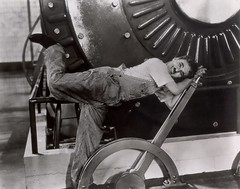
Perhaps right from the get-go, Chaplin aimed to do just that. Modern Times' initial placement of the Tramp in a factory, working hard--a lot of elbow grease--just to keep up with a gargantuan and largely symbolic machine conjures an instant contrast of the film's broader, diegetic look at the world. This is the world of the blue collar worker, the entry-level serf in general, but focused upon the specific events of the Tramp's life in each particular setting. As the scenarios shift, it's important to remember that Chaplin keeps the action and the camera specific. As a result, we care when the Tramp's unable to keep pace with the inhumanly fast machine and loses his job and must find another or face starvation. It's not just his antics that render him sympathetic, even loveable. In this instance, the Tramp could have left his job forlorn and sweetly helpless, but he chooses instead to fight back.
By returning to that essential conflict between the dehumanizing setting of the industrialized labor force and the privations of a costly "freedom" from the workplace, Chaplin eliminates the need to hammer home the lack of a happy medium. Our hero is a hero because no matter what he tries, he will fail, and yet he doesn't give up--an understatement about the inability to be truly happy indeed, and perhaps the strongest evidence of the Tramp's threat to capitalism. The story's carefully chosen boundaries cue the audience; contextually, we understand that whether a pursuant of the American dream works in a steel mill, a shipyard, a department store, a machinist's or a restaurant that the dream he chases operates as a relentless and teasing pahntom--as elusive as the "happily ever after" ideal it connotes.
Upon that rusty spindle winds this comedy and love story between the Tramp and a feisty street urchin. By keeping the Tramp and his girl's predicaments and foibles (and their reactions) in the present, Chaplin also syncopates the audience's emotional responses with the events on screen. Partly through the use of fantastic sequences (such as the Tramp finally succumbing to the machine's pull and being rolled through it, the suspension of disbelief takes on a new dimension that allows the fact of the Tramp's firing to retain some element of surprise.
The balletic execution of the scene inside the machine strikes an iconic chord that renders the metaphor of the workingman's doldrum days from birth to death laughable and poignant at once; and so, even though the Tramp's job loss itself could be construed as perfectly logical, the subsequent disappointment is delicate, manifold. More importantly, none of the co-workers (and certainly not the boss) witness this swan dive into the machine. At this juncture, the relationship between the Tramp and the audience becomes sacrosanct; all other characters within the film are of secondary importance to his plight. The audience wants the Tramp to win the day.
After having taken such pains to elicit audience loyalty through cinematography and story choices, several other factors serve to reinforce some very simple distinctions. The sensitive Tramp has no qualms about giving the street urchin a fur coat in which to snuggle; but he is still a poor man, and he wears the implication even as he roller skates in the department store late at night. The camera employs wide-angle shots to impart a sense of danger, of precariousness, as he skates ever closer to the edge of the unguarded balcony, a sign that the hero is brave and perhaps in need of a little protection from himself. That sense of danger plays throughout the film, though, and it often lies outside of the Tramp's means to tame it: the factory owner's Big Brother-like monitoring and pushing of his machine to full production capacity; the Tramp's nervous breakdown that places him yet again in the care of mental and social workers and inadvertently triggers a jailbreak; and the peril of working in a department store while it's being robbed by men on the verge of starvation themselves. To these scenes Chaplin entrusts the Tramp's relative ignorance of the world against which he is defenseless, cueing the audience yet again not only with plot points (one of the robbers is a former steel mill co-woker) but also with character blinds.
The explicit meaning derivates from the film's surface scouring of the American dream, acting in accordance with its referential meaning--that working hard and saving pennies will earn enough to make such a dream a reality. The implicit meaning, though, speaks of a deep restlessness obscured by society but ever-present and ultimately a real threat to the happiness of anyone who buys into such a dream as truth. In fact, by equating the "happily ever after" scenario with that dream, Chaplin seems to be suggesting that all such idealistic pursuits should be understood to be the stuff of films and storybooks, and not the larger reality of America's working class. If so, he nearly got away with it cleanly.
In tune with the atmosphere of the Industrialized Depression, Modern Times feels symptomatic of the concern about the exponential growth of the middle classes. Only thirteen years after the film's release, George Orwell would publish 1984 and ergonomics would officially become an applied science. While Orwell's text would be considerably darker than Chaplin's fare, both stem from a conflict between individual freedom and the ever-narrowing alternative in a society purporting to be free yet camouflaging what precisely that means. As ever, it is up to the protagonist to define it for himself.
On one last note, while looking for parallels between Modern Times and more contemporary media, several suggestions bubble to the surface. The Norma Raes and Gung Hos of this world aside, perhaps my favorite connection would be Laverne & Shirley. The parody of two working women chasing the Tramp's unattainable dream of freedom through labor and equality seems likely, especially with Lenny and Squiggy as the only love interests in sight. American dream, what?
This is the first entry. The second is a look at maternalism in the '40s classic films My Favorite Wife and Meet Me in St. Louis...
If you polled an informed film audience as to which Chaplin film was the best, you'd invariably meet with obstinant answers pointing to Buster Keaton and Harold Lloyd as the more talented comedians of the day. Luckily, I'm not interested in anything hued with hissing hyperbole, especially not regarding the bygone days of silent film and its attunement to mass culture. What does interest me, though, are general impressions of this particular take of Chaplin's. Often labeled as prescient or foreshadowing, a note that I barely brushed upon in my initial, synoptic review, this film has summoned me back for a closer look. I invite you to do the same with me, keeping in mind that the film was made by a man who, for better or for worse, outshone his peers and engraved himself indelibly upon mass consciousness as a classic character and filmmaker--a feat a lot of people have wasted good money to learn.
Perhaps right from the get-go, Chaplin aimed to do just that. Modern Times' initial placement of the Tramp in a factory, working hard--a lot of elbow grease--just to keep up with a gargantuan and largely symbolic machine conjures an instant contrast of the film's broader, diegetic look at the world. This is the world of the blue collar worker, the entry-level serf in general, but focused upon the specific events of the Tramp's life in each particular setting. As the scenarios shift, it's important to remember that Chaplin keeps the action and the camera specific. As a result, we care when the Tramp's unable to keep pace with the inhumanly fast machine and loses his job and must find another or face starvation. It's not just his antics that render him sympathetic, even loveable. In this instance, the Tramp could have left his job forlorn and sweetly helpless, but he chooses instead to fight back.
By returning to that essential conflict between the dehumanizing setting of the industrialized labor force and the privations of a costly "freedom" from the workplace, Chaplin eliminates the need to hammer home the lack of a happy medium. Our hero is a hero because no matter what he tries, he will fail, and yet he doesn't give up--an understatement about the inability to be truly happy indeed, and perhaps the strongest evidence of the Tramp's threat to capitalism. The story's carefully chosen boundaries cue the audience; contextually, we understand that whether a pursuant of the American dream works in a steel mill, a shipyard, a department store, a machinist's or a restaurant that the dream he chases operates as a relentless and teasing pahntom--as elusive as the "happily ever after" ideal it connotes.
Upon that rusty spindle winds this comedy and love story between the Tramp and a feisty street urchin. By keeping the Tramp and his girl's predicaments and foibles (and their reactions) in the present, Chaplin also syncopates the audience's emotional responses with the events on screen. Partly through the use of fantastic sequences (such as the Tramp finally succumbing to the machine's pull and being rolled through it, the suspension of disbelief takes on a new dimension that allows the fact of the Tramp's firing to retain some element of surprise.

The balletic execution of the scene inside the machine strikes an iconic chord that renders the metaphor of the workingman's doldrum days from birth to death laughable and poignant at once; and so, even though the Tramp's job loss itself could be construed as perfectly logical, the subsequent disappointment is delicate, manifold. More importantly, none of the co-workers (and certainly not the boss) witness this swan dive into the machine. At this juncture, the relationship between the Tramp and the audience becomes sacrosanct; all other characters within the film are of secondary importance to his plight. The audience wants the Tramp to win the day.
After having taken such pains to elicit audience loyalty through cinematography and story choices, several other factors serve to reinforce some very simple distinctions. The sensitive Tramp has no qualms about giving the street urchin a fur coat in which to snuggle; but he is still a poor man, and he wears the implication even as he roller skates in the department store late at night. The camera employs wide-angle shots to impart a sense of danger, of precariousness, as he skates ever closer to the edge of the unguarded balcony, a sign that the hero is brave and perhaps in need of a little protection from himself. That sense of danger plays throughout the film, though, and it often lies outside of the Tramp's means to tame it: the factory owner's Big Brother-like monitoring and pushing of his machine to full production capacity; the Tramp's nervous breakdown that places him yet again in the care of mental and social workers and inadvertently triggers a jailbreak; and the peril of working in a department store while it's being robbed by men on the verge of starvation themselves. To these scenes Chaplin entrusts the Tramp's relative ignorance of the world against which he is defenseless, cueing the audience yet again not only with plot points (one of the robbers is a former steel mill co-woker) but also with character blinds.
The explicit meaning derivates from the film's surface scouring of the American dream, acting in accordance with its referential meaning--that working hard and saving pennies will earn enough to make such a dream a reality. The implicit meaning, though, speaks of a deep restlessness obscured by society but ever-present and ultimately a real threat to the happiness of anyone who buys into such a dream as truth. In fact, by equating the "happily ever after" scenario with that dream, Chaplin seems to be suggesting that all such idealistic pursuits should be understood to be the stuff of films and storybooks, and not the larger reality of America's working class. If so, he nearly got away with it cleanly.
In tune with the atmosphere of the Industrialized Depression, Modern Times feels symptomatic of the concern about the exponential growth of the middle classes. Only thirteen years after the film's release, George Orwell would publish 1984 and ergonomics would officially become an applied science. While Orwell's text would be considerably darker than Chaplin's fare, both stem from a conflict between individual freedom and the ever-narrowing alternative in a society purporting to be free yet camouflaging what precisely that means. As ever, it is up to the protagonist to define it for himself.

On one last note, while looking for parallels between Modern Times and more contemporary media, several suggestions bubble to the surface. The Norma Raes and Gung Hos of this world aside, perhaps my favorite connection would be Laverne & Shirley. The parody of two working women chasing the Tramp's unattainable dream of freedom through labor and equality seems likely, especially with Lenny and Squiggy as the only love interests in sight. American dream, what?
Labels: Bordwell and Thompson Series, Chaplin, Politics
posted by Jo Custer at 8:18 PM
2 comments