Tuesday, April 03, 2007

Low Key Lighting in a Billy Wilder Noir

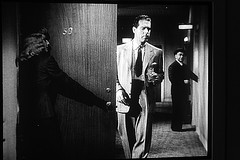
The opening sequence of Double Indemnity sets the tone and the pacing of the entire film. In roughly ten shots, a car careens in the middle of the night and runs a stop light before finally parking in front of a locked, dark office building. Within moments, the audience can see that the man in the car is a trusted employee of an insurance firm, that he has been shot, and that he is spending what might be his final moments recording a confession via Dictaphone for his boss and role model to discover after he’s gone.


By the second scene, the audience has been informed of all that has happened; what’s left to ascertain is how it happened. The insurance salesman’s Achilles heel and foreshadowing for the film make themselves known in that next, vital scene. Symmetrical cinematography provides a solid basis to grasp how it is that the hero is taken in and left for dead, but the camerawork also uses gentle subterfuge in the meeting scene between Walter Neff and Phyllis Dietrichson that creates a lopsided sense of space and a power balance between its main characters. Since the plot’s mainstay composition is the power struggle between these two, studying this scene lends insight and even some stability to what is a very steamy and turbulent romance-murder. It is the events of the second scene upon which the protagonist can ruminate and conclude that that’s the point at which he should have walked away; so, it is no mistake that a dying man begins his story here.

The first shot of the second sequence establishes the expensive house set on a nice vista where a simple pan reveals children playing ball in the driveway and an ice cream truck taking a leisurely drive through the neighborhood. The sense of movement in this first shot establishes the flow as the ice cream truck proceeds off screen in the opposite, angled direction that Walter Neff goes as the camera tilts and he ascends the elegant stairs. The camera then renders a medium shot of Neff as the housekeeper answers the door. Their conversation is shot almost completely as an exterior shot, but Mrs. Dietrichson, whose husband’s insurance coverage is up for renewal, appears in nothing but a bath towel on a railed landing at the top of the stairs. The frame quickly cuts from an interior medium shot of Neff with the housekeeper to the lady of the house up above them.

The low angle of the shot at first reveals nothing more spectacular than Phyllis Dietrichson’s scantily-clad appearance, but the return shot on Neff as he takes off his hat is a high angle shot, somewhat closer. It is in this interplay that the first power struggle takes place, but it won’t be the last. Mrs. Dietrichson ventures closer to the railing in the next cut back to her, unafraid to let him see her even as the housekeeper watches. Though prescribed societal roles would suggest that the woman should feel more vulnerable in a situation such as this, it is the insurance salesman who is disarmed in a second high angle shot, perhaps even fooled by a return to the low angle in which Phyllis moves slightly right within the frame, somewhat obscured by a rug hanging over the railing. Upon the third high angle framing of Neff, he continues the tease in a remark about pigeons, but in the last low angle shot of Phyllis, the angle is much steeper. Her seeming timidity is now understood to be just part of the flirtation; she still seems to hold the upper hand.

At the very least, she clearly asserts her position.

To regain symmetry after this power play, the camera returns to the medium shot that normally would have followed Neff’s entrance more substantially. This time, though, the lighting has brighter notes, as if the two had stepped into the light and Neff had all but revealed himself. The camera pans to the living room as Neff walks toward it and then cuts to an establishing shot in which only the entrance of the living room and the mirror can be seen in the foreground, while the staircase from which Phyllis must eventually descend comprises the ominous background. All of the shots thus far have been angled in such a way to keep movement in a uniform position, and the shot of the staircase follows suit; i.e., the direction of the stairs inside the house matches those without the house.


To lend the living room a sense of 360 degree space, the camera then follows Neff around the room in a carefully constructed manner. He walks to the piano in a pan shot, the camera cuts to an over-the-shoulder close-up of pictures of Lola and Mr. Dietrichson, and the audience is greeted with a second establishing shot of the greater part of the living room, in which the two will spend most of their time together in just a few minutes. At the tail end of this series of shots, there’s a slight pan to follow Neff’s movement, but the camera stops and he walks into a spot of light. The next cut reveals a close-up tracking shot of Mrs. Dietrichson’s feet descending the inevitable steps. A quick zoom-out at the bottom of the steps reveals that she’s just now finishing up with buttoning her blouse, and the shot continues tracking until she goes to the mirror to admire herself and exits the shot. Neff follows her out of it, too, as the camera remains more or less on the mirror.

This sort of stop-gap sense of motion continues. Just as Neff paced around the room in a circular manner, now Phyllis will pace, too, as part of her coquettishness. But special attention should be paid to symmetry, also. First, the characters sit down into a still medium shot, she in a chair somewhat lower than him and he on the arm of the couch. Thus the second power play begins. He notices her anklet, and she uncrosses her legs. The camera tilts and pans as Phyllis gets up from the chair and it pans back and forth as she paces. When she pauses to ask Neff two questions, a brief cut reveals a medium shot of Neff still sitting on the arm of the couch, now somewhat lower than her. The camera returns to Phyllis, panning again as she resumes her seat within the same frame the pair originally sat. She re-crosses her legs and Neff’s attention is once more seized by the anklet, made clear by a close-up on his face. It’s also the cue for the third power struggle in the scene.

The camera tilts, pans and slightly zooms in on the two as they stand and move clear of the couch. It’s as close together as they get in this scene while facing each other. A close-up on Phyllis as she tells Neff that there’s “a speed limit in this town” is quickly followed by a close-up on him telling her to give him a ticket. The next and last close-up Phyllis mentions her husband and the flirtation swiftly ends. Or so it seems.

In the final shot of the scene, the camera’s medium tracking shot on Neff traces their path into the living room in the first place. First, it moves to the mirror where he reclaims his hat and then to the door, where the two have one final exchange of words. It is clear from the way the scene ends that whatever happened between these characters has not ended, but rather just begun.

The most tangible words of the opening sequence is probably the bit about how Neff “didn’t get the money, and [he] didn’t get the woman.” There’s an ambling sense to this scene, in the way that the motion is constructed, that sets off the inevitability of the entire affair – romance and murder, to boot. It’s as though just in the course of daily motion (a prerequisite in the insurance business) that a person can never foresee very well in what direction his life might go at any moment, not even an insurance salesman.

Labels: , ,

Sunday, September 24, 2006

Double Indemnity (1944)


Dir. Billy Wilder
Writ. Billy Wilder, Raymond Chandler; based on James M. Cain's novel
w/ Fred MacMurray, Barbara Stanwyck, Edward G. Robinson, and Jean Heather

Trying to reconcile himself to the person he's closest to, insurance salesman Walter Neff surrendurs the truth of the events leading up to a fraudulent scam in which his lover's husband can produce a golden egg by dying accidentally on a train. The voice over narrative, ever reminiscent of the opening scene of Neff careening recklessly to get to the office, leads a suspensful and introspective domestic nightmare. As he's pulled ever deeper into Phyllis Dietrichson's machinations -- sympathizing with her dread of the abusive, alcoholic terror awaiting her at home -- he learns that all is not as it seems. Their lopsided love affair staggers between the twisted passion that arises at the prospect of ridding the world of one man and the thrill of plotting a scheme that would go all the way, no hiccups, straight down the line.

If ever a writing duo wove an unsung swan song, Raymond Chandler and Billy Wilder did when they penned this lush but terse and often powerful landmark film. [1] Although owing a lot to earlier noir-like flourishes, Double Indemnity remains an enigmatic foreshadowing of the subsequent emergence of American crime novel fixation in Europe, and film historians usually diagnose this as the first complete noir expression. [2]

All the elements of classic filmmaking, though, combine to render an intriguing and unparalleled feature that bears, as part of the ironic legacy of its title, the dual blessing and curse of reflexive history. In response to its less than immaculate reception at the Academy, Wilder sank his disappointment into his follow-up, The Lost Weekend (1945), which snagged the same majors as rival Leo McCarey for Going My Way (1944). Wilder's competitive nature probably explains most of the seeming jest of experiencing a sense of personal failure for not having made it big at the Oscars, even in light of the fact that until the 1960s, the Academy Awards were considered by more than just the Hollywood sector of the industry to be the last word in quality. Taking in the film as a whole, however, leaves a question as to what kind of director couldn't simply take pride in his work, award winner or not.

For one thing, Fred MacMurray turns in a to-the-letter performance as the salesman taking the irresistable challenge of the ultimate sale, kindling his obsession with perfection. Barbara Stanwyck, burdened with the necessity of playing off not only her co-star but the voice over, radiates an alternating little girlishness and an older woman's aloof but accessible charm. The combination's heady and alluring and wouldn't be equaled again until Mike Nichols's The Graduate (1967). But Edward G. Robinson's little man, Barton Keyes, brings a character to the screen so rich with nuance and mannerisms that his naturality as the anchor of this small insurance world oftentimes goes completely unnoticed. It's as if the sun may rise and set elsewhere, but in the black and white world of eternal noir night, the bottom line sets the bar.

To counteract that direction and to give the film a bit more breadth, perhaps, we're introduced to a fourth character, Lola, Phyllis's step-daughter. She brings back some of the daylight and a naive quality that leaves her fragile and confused, only the appropriate reaction to the world spinning out of control around her. Descriptions of sensory influences blend with Lola's simple presence in the film as a reminder of everything that the insurance business purports to protect but instead betrays.

It's so easy to be debauched by Phyllis and Walter's seductive relationship that it's even easier to forget their penchant for murder, thanks to the incredible work of cinematographer John Seitz and the chemistry between MacMurray and Stanwyck. Every gesture, every glance, charges the air around them with intrigue and excitement so compelling that even the smallest objects around them transform into conduits for those feelings. The stacks of canned goods on the grocer's rationed shelves become Aztec cities; the phone booth transcends its geography to suggest howling winds that must be hushed into reverence; and honeysuckle smells famously like murder.

The most awing and humbling act arrives when, having been caught up in the dirty business of covering up their crimes, Neff does his best to make things right. He may be a little late, but after all the madcap racing around, his effort speaks quietly of a man who recalls that life offers more than the option between the grind or a heist. Partly due to Lola but mainly because no man likes to be tricked by someone he cares about, the film's finale reverberates with the simple reminder of things that all of us need to be able to count on but can take for granted way too much. Even those not easily succumbing to the thoughtless whispers of a dark and dreary night in nowhere.


[1] Crime novelist Raymond Chandler wrote the screenplay for Alfred Hitchcock's Strangers on a Train (1951) in addition to whipping up the dialogue with Wilder from Cain's novel, which was originally entitled Double Indemnity in Three of a Kind. If titles are any indication whatsoever of writing abilities, suffice to say it's a good bet that the film's substantially better.

[2] A year too late to make the grade, Edgar G. Ulmer's Detour (1945) struck a similar note as a classic that would be all but forgotten upon release, only to be dug up by film historians who, presumably, preferred the indie director to Wilder.

Labels: , , ,

Sunday, December 11, 2005

Out of the Past (1947)


Dir. Jacques Tourneur
Writ. Daniel Mainwaring, James M. Cain, and Frank Fenton, based on the novel by Mainwaring
w/ Robert Mitchum, Jane Greer, Kirk Douglas, Rhonda Fleming, and Paul Valentine

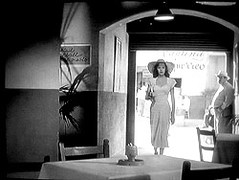
Robert Mitchum operates tepidly as private investigator Jeff Bailey, hired by a muddled Kirk Douglas to retrieve the sultry Jane Greer who has shot him and taken $40,000 from him, adding insult to injury. Bailey tracks down the lone gunwoman only to end up trysting with her on a secluded beach, in a beach house, and at other hideaways. Everything goes swimmingly until the boss shows up, expecting results, and things turn convoluted and considerably less than thrilling.

Crisp pictures and nicely varied settings provide more writing than the writer felt obligated to; the plot - even with the narrative aid - is so disjointed that the story's just not compelling. Depending upon the viewer's school of cinematic thought, it seems likely that a more linear approach to the events would have at least given Out of the Past the advantage of common sense. Ironically, though, its use of flashback also serves as one of the few aspects keeping the viewer awake.

As backstory, Bailey had already retired at the opening of the film, running an independent garage in the middle of nowhere with nobody besides a deaf and dumb sidekick to help him. His relationship with "the Kid", as he was dubbed, holds some endearment. They trust each other and, when needed most, the Kid proves instrumental in saving Bailey's life. For several moments, it almost feels like you're watching a real crime drama instead of a stab at one.

The combination of Mitchum's relaxed, almost limpid approach to acting, a strangled storyline, and some pretty poor directing create a general atmosphere of ennui. Despite lots of sex it isn't very sexy, and more like film blah than film noir. If for one moment, the awol lovers had been convincing; or, the bad guys had been truly bad instead of mildly annoying; or, the sets hadn't been more interesting than anything going on inside of them, this could've been a watchable film. Instead, it exists as a fully edited, intact relic to what should have been a vaguely noticeable crunchy sound on the cutting room floor.

Probably only for hardcore Greer, Mitchum, or Douglas fans (although it will help unspeakably if you happen to like all three), this remains a question mark on Time magazine's list of the "100 Greatest Films" of all time. After turning Out of the Past off, you may breathe a sigh of relief that you can return to normal, exciting life. It begs the question of whether the list's compiler somehow momentarily forgot the title of his assignment. An obscure entry into the noir genre, it stands out in neither its own class nor in the wider sphere of the fim universe as anything beyond a passing fancy...view at your own risk.

Labels: , ,