Wednesday, May 23, 2007

The Distantial Storytelling of Fellini's Amarcord (1974)


More distantial from the eye. -- W. Montagu

If editing is the act of storytelling through the careful control of audience attention, then Amarcord might be considered a quixotic example of separating the audience from the story through a "pushing back" of the narrative. Cutting techniques create a staccato sense of interaction in this isolated seaside village in Mussolini's Italy, both through overlapping dialogue and the tumbling of action upon action which the sound augments and enhances. While the story itself takes a long time to build and each frame depends upon the last, the film often feels like the movement hovers indecisively between motionless dreamscape and acceleration threatening to derail the entire train. The disorienting effect of the editing allows the audience to glimpse a village caught somewhere between antiquity and modernity in a naive, highly impressionable state and serves the film's greater purpose. It should be noted that the title means "I remember," but these memories are not those of the audience any more than this country's history can be claimed by many of the film's viewers.

While it might seem an odd choice to paint the people of a country going through a sweep of fascism as naive and vulgar and laughably gullible by turns, the approach has the steely ring of honesty; and so, Fellini does not shy away from depicting an Italy star-struck by Hollywood and crumbling at its core between external political pressures and perplexing internal religious demands. Perhaps in an attempt to uphold the old saying that a country is never greater than the spirit of its people, Fellini uses the editing to allow each character as much realism and depth as possible while capturing the folly and peculiarities such a society would have bred and fostered, like the confusion concerning sexual matters. He does this so well, in fact, that it can become nearly impossible to see the Italian people of this time period in any way differently from these characters whose civilization threatens to topple the last vestiges of their innocence and uniqueness. Like any encroaching kingdom, fascism and Hollywood become villains; or, at the very least, partners in crime as the attraction to the powerful El Duce by the town's most eligible single woman can easily be viewed in tandem to her fascination with the screen -- or, perhaps, with Gary Cooper.

It comes as little surprise that despite the vignettes, Amarcord focuses on one family in general and its elder son in particular. The film needed some glue between its audience and its subjects, not only to convey a theme of universality that nearly anyone could relate to, but to root its distantial perspective within a family not overly given to sentimentality. Although an audience member can sympathize with the members of this family, the events and manner of their presentation doesn't allow for too great an attachment to any one thing, place or event. Their interrelationships so small amid the ruins of a once-great civilization now under Hitler's boring German thumb, they are essentially mere shadows of themselves. Both parents fight and exhibit so many childish qualities that marital harmony seems impossible in such a society, and the only thing certain is the knocking of the undertaker. These quibbles pebble the action without defining it, though; the main focus still remains on the son who is the future of the family and the country and, quite possibly, the equally anonymous "I" in "I Remember."

In light of the connection between the camera's focus and the antics of a young man, it could be further suggested that the film doesn't merely convey spatial realtions to keep the audience at a distance but to convey a sense of futility. Looking at the filmic movement toward separation and away from togetherness, especially in the scene introducing the family's Mad Hatter, what Fellini appears to be saying is that closeness (i.e., happiness) under the circumstances was nearly impossible. Our first knowledge of Uncle Teo begins with a rough cut from the Grand Hotel's silhouette (where the town's peddler and yarn-spinner Biscein supposedly once had intercourse with 28 concubines) and the film's recurring, romantic theme music to a day-lit reality. Before the frame can fade either visually or aurally with grace, the next frame shows Teo standing behind an iron mesh gate, surrounded by other hospital patients who await the arrival of his family with him. The roughness of the cut re-focuses the audience on the family that the film has wandered from tangentially while aiding the contrast between the two specific images. The next frame then shows the elder son jumping into the air to see over a stone wall, along which he must walk to get to the outer gate to greet his uncle.

The use of walls and other dividers in Amarcord is not coincidental. Since Fellini essentially shows the colliding of worlds in Italy at this time, the tendency to try and fence the familiar world in -- as when Miranda locks Lallino in the yard while the fascists demonstrate nearby -- is as natural as the tendency toward voyeurism when looking upon something strange and new. A great sense of division is achieved by these fences and walls and gates, and the editing in the tree scene supports that sense as an extension of those same walls, be they made of stone or strained social barriers too thick to understand let alone overcome. In a way, Fellini has given voice to the frustrations of his more empathetic characters through Teo's madness, so when he climbs a tree in the open, deserted countryside and yells, "I want a woman!" over and over again, the interplay between the characters tells of the real rift between these people even as the act itself echoes the feelings embedded in every male in the film (except the fascists). Soon, La Gradisca's rejections of the young man's advances in favor of daydreaming about Gary Cooper or chasing after royalty, will send him into a feverish and pitiful state, but Teo's approach now makes him laugh. His youth can only see humor in Teo's situation.

As the elder son relays play-by-play to his mother what happens in the tree after several people -- including him -- have tried to get his uncle down only to be met with a rock on the head, his dialogue reinforces the film's concentration upon distance. Amarcord largely lacks close shots, relying heavily on medium shots, many of which are either establishing or re-establishing, and that's no mistake. Even the closer shots are never too close. Teo's ascent registers only as a medium shot that takes in most of the tree and then re-establishes his position in the tree from the side. As his nephew announces the attempts to get him out of the tree, he has been pushed to the background. The young man stands in the foreground and broadcasts the goings-on to his mother, as equidistant from her as from the tree, unable to get closer to anyone or do anything else, like any storyteller dealing in the past. The scene's relief culminates in the arrival of a hospital vehicle and a couple of workers whose number includes a dwarf nun. That she is able to get Teo down by merely snapping at him is an interesting social commentary on the times. The message seems to be that things were so out of whack that only a dwarf nun could cut through the madness; but even that's a quick fix and not a permanent solution. The camera remains at the same angle and distance to watch Teo go.

Later, Fellini uses an unlikely scenario to create a greater sense of displacement and confusion just before arriving at what might be the most poignant moment in the life of an elder son. Beseiged by snow taller than a man, the town square now looks like ice fjords cut in funny, European road-like patterns and into this walks La Gradisca dressed in her signature scarlet. Her admirer spies her and follows her into the maze, calling her name, and Fellini breaks the 180 degree rule so that the young man's disorientation with his surroundings becomes ours. What he finds are the church caretakers who enquire about his mother, introduced in an interesting cut sequence lying outside of the normal parameters of American editing at that time. In the first shot, we gaze upon the front of the church, linked with the boy's disappointment that he did not find the object of his desire. There's a cut away to the boy's face, and then one more cut to a shot of the caretakers who have magically appeared outside the church or have just now caught the boy's attention. Either way, without any time lapse evident in the cut, the emphasis upon the boy's search for something he can not have over the reasoning for why he wouldn't have seen the men in the first place lends an eerie, supernatural quality.

After all, the young man replies that his mother is better because she's been taken off the critical list, too naive to realize that there is simply nothing more that can be done for her; but further, his chasing of an older woman before he's even relinquished of his mother's care takes on greater meaning. So when the son leaves the church and the camera assumes a considerably higher angle re-establishing shot from the opposite corner of the square, the young man and La Gradisca can be seen walking only yards apart from each other in opposing directions. The snow between them is as much fancy and tomfoolery on the director's part as is the impetus for the schoolboy crush; it is enough that he returns to greet his mother one last time before her death. The symbolism thus granted the matriarch washes over all of Italy, then, with this image of a woman dying because of a naivety and helplessness that at the same time serves the country as an identifier -- and an endearing identifier at that. When La Gradisca marries a fascist officer, the fate of the nation lingers on the brink of destruction. A voluptuous woman has decided to settle for something less than ideal, and perhaps Fellini includes more than just Mussolini's Italy in this studied gaze. Perhaps he also speaks of Rome, or of any nation that once had delusions of grandeur enough for an entire world but ended in a shrug and a sigh. That would certainly justify his paralleling of such notions with the ambitions of youth, had that been his thinking.

It is entirely possible, though, that Fellini over-sentimentalized his own youth once and that the loss and transfiguration he felt afterward informed this work and its more conscious decisions in ways not evident on the screen. The romanticization of conflict is apparent in the portrayal of the young man's ardent pursuit of a woman out of his league, in the flagrant juxtaposition of the country and the imposing State. He does not need to point to it. He lets the images do that for him, and the music. Throughout the carefully distant spatial relations, there's a struggle between diegetic and non-diegetic sound. The song Stormy Weather (in English) can be heard throughout the film's diegesis, be it whistling or strange singing that we are left to assume is a phonograph playing somewhere just out of sight. Meanwhile, the non-diegetic repetition of the more Italian theme song treats the film to a bittersweet serenade that can be at times a part of the film's natural score -- e.g., when the blind accordion player is in sight -- but usually is not. During the family dinner scene toward the beginning of the film, as the basic rift between father and son is being set up, Stormy Weather is actually playing from an unseen but presumably natural, muted source as the father re-enters the room after learning of his son's mischief the previous night. He enters whistling an anthem of the State, in direct opposition to the sentimental American song, and misleading of his character. But at that moment, he is the authority figure who must deal with his son's behavior, and he does so with deception, asking the boy cheerfully about his trip to the movies.

And at that moment, the essential conflict of country identity has been set up. The boy chatters on about the American Western and we are left watching the father chase his son around the house, trying to bully him into behaving more responsibly. It is understood that American culture has infiltrated Italy, that it is perhaps even soporific to the Italian people, and that fascism and laziness will prevail in a country not guarded well enough against either. In that sense, the presentation of the townspeople in relation to each other -- distant, yet familiar -- acts as a sort of cinematic optimism. The nuclear family and its privacy may be threatened by the State, and the traditions and customs of Italy may be giving way to other more dominant cultural trends, but as long as the world is still peopled with striking, autonomous individuals there is still some hope and something worth remembering. I'd like to think that Fellini was thinking something a little more like that.

But hey, that's just me.

* * * * * * * * * * * * * * * * * * * * * * * * * * * * * * * * * * * * * * *

This is the omega chapter in a look at several films with the aid of Bordwell and Thompson's fine book, Film Art. I can't recommend the volume enough to those unfamiliar and curious.

Other entries include the following articles:

5. Sound & Sympathy in Terrence Malick's Badlands (1973)
4. Low Key Lighting in a Billy Wilder Noir
3.Things Happen: Reversals of Fortune in Ford's Stagecoach (1939) & Sirk's All That Heaven Allows (1956)
2. Maternalism & The Female in My Favorite Wife (1940) and Meet Me in St. Louis (1944)
1. Modern Times & The Post-Industrial Dream

For the whole megillah:

Bordwell & Thompson Series

Labels: ,

Monday, April 23, 2007

Sound & Sympathy in Terrence Malick's Badlands (1973)

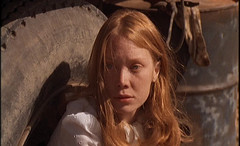
Terrence Malick's haunting, lyrical re-envisionment of the 1950s Starkweather-Fugate killing spree provides an interpretative and non-judgmental perspective of what it might have been like for a fifteen-year-old girl to have absconded with her father's murderer and passively participate with the subsequent domino-like murders that followed. Through a combination of sound techniques, the subtler, more nuanced aspects of the story help to shed light on how a situation like that might have played out in real life. Told in a sparse voice-over with a reflective journal writing-like quality and a series of non-traditional sound choices, Badlands manages to convey the empty, nowhere feel of a small town where boredom might prevail over reason.

Malick shows that ennui like a hairline fracture, separating its two main characters -- Kit and Holly -- from everything but their most natural surroundings. That implicit, diegetic context imbues the film with a great sense of symbolism concerning the loss of innocence, coming of age, and self-realization; and, as the story progresses and Holly simultaneously comes out of shock and withdraws from Kit, the voice-over takes on new strength and self-awareness -- just like any journal would when the writer, secure in solitude, abandons everything but her own voice.


Holly chooses a different path...

Similarly, sounds that are and aren't used in Badlands denote certain moods and reinforce the disconnect between these characters and their environment. Kit cuts out early from collecting trash in the opening scene and stops to crush a can under his boot in the alley, and then kick it away. Meanwhile, Holly practices baton twirling quietly during her voice-over. Later, when the father discovers his daughter has become intimate with Kit, her mouth moves soundlessly and instead we hear her voice over telling us about her father punishing her for it by shooting her dog. We also hear the gunshot. Kit sits up awake in bed during another voice over which tells us, without letting us listen along, that he hears what sounds like the sea in a conch shell when he's away from her. In both of these instances, the film allows its audience to infer by imagination how these scenes may sound and feel; they are contemplative and open to interpretation, inviting and engaging the senses to open up to these two characters and their unusual and normally unsympathetic dilemma.

Certain other omissions in the soundtrack stand out as well. One interesting consideration is that many unpleasant or simply more mundane sounds don't reach the audience's ears, such as the cattle feeding when Kit gets hired on a ranch after losing his position as a trash collector. Instead, we hear Holly's sweet, lilting voice-over and are left to infer that Kit's mind is, as she he claims, elsewhere and more with us as we watch them. That binding effect between audience and characterization works well, and Malick is very careful not to throw in any distractions, rendering the "noise" level of Badlands practically non-existent. Like a good poem, there is no extra line, word, or letter that does not serve some muscular purpose to the film's bare bones. Diegetically, we hear only the sounds that hold importance or significance to its characters, and the absence of diegetic music speaks volumes. Holly tells the audience about her piano lessons, but we do not hear them; likewise, when we are told that her father has switched her lessons to concentrate on the clarinet as a way of making a lady of his wayward daughter, we do not hear the clarinet either, not even when we see her with the reed in her mouth. This not only serves to evoke the truer world of the characters' inner lives but to create a great sense of quiet, lucid emptiness within the frames.

Only a moment after Holly, still and silent clarinet in hand, runs to greet her father coming home, the scene in which Kit shoots him begins. Thus far, the sequence of events has been natural: the couple has met and fallen in love, and Kit has approached his girlfriend's father to attempt have a man-to-man conversation with him. Yet the underlying events upset the balance of things: Kit is twenty-five to Holly's fifteen, and she lied to her father right after meeting the significantly older man. We hear the lie in direct dialogue in an otherwise affectionate scene and then the next time we see Kit and her together, birds are chirping lazily in sunshine and their relationship is obvious and progressing quickly. So when he shows up after failing to get any satisfaction from his girlfriend's father about being left alone to enjoy his time with Holly, and enters the house to start packing her clothes without speaking to her about it, the unnatural act of entering seems more natural than it otherwise might. Had it not been for the gun in his hand, both the real life story and the film would've gone much differently. [1]

But Malick makes as much use of the small-town sounds as possible to house the first and most important shooting scene in a sturdy, almost amicable fashion. Directly after the shot, a neighborhood dog barks. Kneeling by her father, we hear the words, "This is Holly," delivered by a Spacek completely in touch with the fact that her character has little identity to lose. The use of music is minimal and accompanied by rocking, handheld camera movement that conveys almost a slight Dutch angle sense that helps to keep the audience in suspense as to what kind of character Kit might turn out to be after all, now that he has evolved from reticently charming to wieldy. A cut to the basement where Kit drags the dead man gives way to a cut of him emerging from the basement into cricket-laden evening with a toaster in hand, which he then declares that he has found even though no former dialogue supports that it was lost. We are left, again, to our imaginations to decide how much of the relationship we see unfold is real and how much of it falls into a strained, gray area where two people simply co-exist.

An aural and visual treat, Badlands takes care to ensure that the non-diegetic music does not distract from the story, but enhance it instead. Often the score serves to convey emotions too complex to be translatable through any other means, and these are placed most often in transitions. After Kit leaves the house with the father in the basement, the bereft daughter wanders the upstairs with a cigarette that would have been foreign to her only weeks prior, trying to make some sense of everything that has happened but unable to. This is cued not just by the music but by the lack of voice over when we see her move to a window and watch two boys sitting on a curb across the street. Her separation from her youth before her time is obvious and apparent, and the music grows louder and more frenetic later when Kit sets fire to her house in an attempt to make the entire affair look like a murder-suicide that ended in arson.


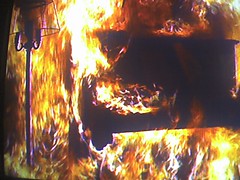
This includes a brilliant scene in which the newly minted murderer records a suicide note that claims that the reasons for the tragedy "are obvious" onto a record that he then places in a turntable on repeat only yards away from the blazing inferno they leave behind. By this point in the film, everything from Holly's childhood has disappeared: her father, her mother's memory, her dog, and her home. As the setting changes from restless town to daunting wilderness in the titular surroundings, the ease with which these two got so far and the understandability of her absolution of him becomes ever more apparent.


[1] It should be noted that Malick took great creative license with the Starkweather-Fugate story. In reality, Charlie (Kit) Starkweather was nineteen and had already killed a gas station attendent when he showed up at the fourteen year-old Caril's house. He murdered both her parents and then proceeded to choke the babysitter to death while his young girlfriend made him a sandwich. It's difficult to get a read on the real-life events and perceptions fifty year later, but somehow Malick recreates a family structure that allows Spacek's character to mature onscreen and be pitted against the popular views of her involvement with Starkweather, which is an interesting commentary in and of itself. In the film, even the Texas Rangers who hunt him down find the mass-murdering Kit charming and respectable while Holly feels the glaring judgment of their captors.

It seems that in reality, Caril Fugate would've received a kinder reception after having both parents murdered and being kidnapped from her babysitter, but it's hard to say where Malick pulled that aspect from. It does, however, make for excellent, character-driven storytelling.

Labels: ,

Tuesday, April 03, 2007

Low Key Lighting in a Billy Wilder Noir

The opening sequence of Double Indemnity sets the tone and the pacing of the entire film. In roughly ten shots, a car careens in the middle of the night and runs a stop light before finally parking in front of a locked, dark office building. Within moments, the audience can see that the man in the car is a trusted employee of an insurance firm, that he has been shot, and that he is spending what might be his final moments recording a confession via Dictaphone for his boss and role model to discover after he’s gone.


By the second scene, the audience has been informed of all that has happened; what’s left to ascertain is how it happened. The insurance salesman’s Achilles heel and foreshadowing for the film make themselves known in that next, vital scene. Symmetrical cinematography provides a solid basis to grasp how it is that the hero is taken in and left for dead, but the camerawork also uses gentle subterfuge in the meeting scene between Walter Neff and Phyllis Dietrichson that creates a lopsided sense of space and a power balance between its main characters. Since the plot’s mainstay composition is the power struggle between these two, studying this scene lends insight and even some stability to what is a very steamy and turbulent romance-murder. It is the events of the second scene upon which the protagonist can ruminate and conclude that that’s the point at which he should have walked away; so, it is no mistake that a dying man begins his story here.

The first shot of the second sequence establishes the expensive house set on a nice vista where a simple pan reveals children playing ball in the driveway and an ice cream truck taking a leisurely drive through the neighborhood. The sense of movement in this first shot establishes the flow as the ice cream truck proceeds off screen in the opposite, angled direction that Walter Neff goes as the camera tilts and he ascends the elegant stairs. The camera then renders a medium shot of Neff as the housekeeper answers the door. Their conversation is shot almost completely as an exterior shot, but Mrs. Dietrichson, whose husband’s insurance coverage is up for renewal, appears in nothing but a bath towel on a railed landing at the top of the stairs. The frame quickly cuts from an interior medium shot of Neff with the housekeeper to the lady of the house up above them.

The low angle of the shot at first reveals nothing more spectacular than Phyllis Dietrichson’s scantily-clad appearance, but the return shot on Neff as he takes off his hat is a high angle shot, somewhat closer. It is in this interplay that the first power struggle takes place, but it won’t be the last. Mrs. Dietrichson ventures closer to the railing in the next cut back to her, unafraid to let him see her even as the housekeeper watches. Though prescribed societal roles would suggest that the woman should feel more vulnerable in a situation such as this, it is the insurance salesman who is disarmed in a second high angle shot, perhaps even fooled by a return to the low angle in which Phyllis moves slightly right within the frame, somewhat obscured by a rug hanging over the railing. Upon the third high angle framing of Neff, he continues the tease in a remark about pigeons, but in the last low angle shot of Phyllis, the angle is much steeper. Her seeming timidity is now understood to be just part of the flirtation; she still seems to hold the upper hand.

At the very least, she clearly asserts her position.

To regain symmetry after this power play, the camera returns to the medium shot that normally would have followed Neff’s entrance more substantially. This time, though, the lighting has brighter notes, as if the two had stepped into the light and Neff had all but revealed himself. The camera pans to the living room as Neff walks toward it and then cuts to an establishing shot in which only the entrance of the living room and the mirror can be seen in the foreground, while the staircase from which Phyllis must eventually descend comprises the ominous background. All of the shots thus far have been angled in such a way to keep movement in a uniform position, and the shot of the staircase follows suit; i.e., the direction of the stairs inside the house matches those without the house.


To lend the living room a sense of 360 degree space, the camera then follows Neff around the room in a carefully constructed manner. He walks to the piano in a pan shot, the camera cuts to an over-the-shoulder close-up of pictures of Lola and Mr. Dietrichson, and the audience is greeted with a second establishing shot of the greater part of the living room, in which the two will spend most of their time together in just a few minutes. At the tail end of this series of shots, there’s a slight pan to follow Neff’s movement, but the camera stops and he walks into a spot of light. The next cut reveals a close-up tracking shot of Mrs. Dietrichson’s feet descending the inevitable steps. A quick zoom-out at the bottom of the steps reveals that she’s just now finishing up with buttoning her blouse, and the shot continues tracking until she goes to the mirror to admire herself and exits the shot. Neff follows her out of it, too, as the camera remains more or less on the mirror.

This sort of stop-gap sense of motion continues. Just as Neff paced around the room in a circular manner, now Phyllis will pace, too, as part of her coquettishness. But special attention should be paid to symmetry, also. First, the characters sit down into a still medium shot, she in a chair somewhat lower than him and he on the arm of the couch. Thus the second power play begins. He notices her anklet, and she uncrosses her legs. The camera tilts and pans as Phyllis gets up from the chair and it pans back and forth as she paces. When she pauses to ask Neff two questions, a brief cut reveals a medium shot of Neff still sitting on the arm of the couch, now somewhat lower than her. The camera returns to Phyllis, panning again as she resumes her seat within the same frame the pair originally sat. She re-crosses her legs and Neff’s attention is once more seized by the anklet, made clear by a close-up on his face. It’s also the cue for the third power struggle in the scene.

The camera tilts, pans and slightly zooms in on the two as they stand and move clear of the couch. It’s as close together as they get in this scene while facing each other. A close-up on Phyllis as she tells Neff that there’s “a speed limit in this town” is quickly followed by a close-up on him telling her to give him a ticket. The next and last close-up Phyllis mentions her husband and the flirtation swiftly ends. Or so it seems.

In the final shot of the scene, the camera’s medium tracking shot on Neff traces their path into the living room in the first place. First, it moves to the mirror where he reclaims his hat and then to the door, where the two have one final exchange of words. It is clear from the way the scene ends that whatever happened between these characters has not ended, but rather just begun.

The most tangible words of the opening sequence is probably the bit about how Neff “didn’t get the money, and [he] didn’t get the woman.” There’s an ambling sense to this scene, in the way that the motion is constructed, that sets off the inevitability of the entire affair – romance and murder, to boot. It’s as though just in the course of daily motion (a prerequisite in the insurance business) that a person can never foresee very well in what direction his life might go at any moment, not even an insurance salesman.

Labels: , ,

Monday, April 02, 2007

Things Happen: Reversals of Fortune in Ford's Stagecoach (1939) & Sirk's All That Heaven Allows (1956)

Since classic Hollywood cinema by Bordwellian definition deals in reversals of fortune ad nauseum, this treatise will examine the specific vehicles of catharsis employed in these next two films. Ford's titular object and Sirk's small 1950s town provide, respectively, compression and the ultimate denouement necessary to off-set its characters' accomplishments, each doing so in a unique way. Where the literal stagecoach brings together a rag-tag ensemble through proximity, the more conceptual town actually eats at the sense of space between two people until it seems like there's simply no room for a relationship. The difference between the uses of mise-en-scene in these films, beyond the obvious adjustment for makeup and costume in black and white, speaks to a meaning deeper than the surface stories. The lighting and setting especially contribute to the psychological parameters of the characters' relationship to each other and to their setting, the cohesive and centrifugal forces of these plots.

Ford was making a Western. A train could have been the natural option of vehicles, but it would have ousted the potential threat of attacking Apaches and allowed its passengers too much leg room. The stagecoach instead redirects the eye to its passengers rather than the setting. The long shot of it moving through the desert establishes and re-establishes the wild surrounding it, both letting the audience know that the gang is on the move and reminding it of what a small capsule careens through this unknown country. Inside, though, space is constructed in such a way to study each character. Since the relationships between certain characters change substantially by the end of Ford's film, special notice should be given to the placement of those characters within the narrative, lighting and the costuming that offers more than standard, Western denotative functions.

Social position feeds the main conflict and resolution of Stagecoach. Although the natives present the variable of a potentially hostile threat, they remain as such; it is the people whose lives intersect on the journey who threaten the peace more intimately. While inside of the vehicle, the shots are largely formal, medium compositions that dance between straight shots and more angled ones. Part of the justification for this lies in keeping the conversation participants and their respective seats in the coach straight, to witness who is looking and speaking to whom and who is avoiding eye contact and discussion. John Wayne, as the black sheep of the pack, sits in the odd seat on the coach's floor, allowing for nearly 360 degrees of camera movement which the cinematographer uses to compress the air between the stuffier inhabitants when appropriate. It also allows for a variety of exterior events to be visible through the coach windows. Partly in keeping with the development of the characters, but also to aid the impact of the eventual surprise of the Indian attack, the camera only leaves the coach interior when the action justifies it wholesale.

The director makes good use of the film's mise-en-scene at the intermittent stops outside of the coach, too. If the coach is his characters' catalyst, the breathers between act as air sacs for expansion upon the theme of social justice. The scene which exposes the society woman to be pregnant provides ample goodies that demonstrate the changes occurring in the group in subtle ways. After she faints at the news of her husband's wounding, the rest of the gang rushes in to see her, and for that brief moment, they are all the closest together that they will ever be. The lighting of that scene has the advantage of existing in one of the larger interior sets used, and it interplays with the suspense not only in terms of shadows against a wall but also in terms of significant costuming highlights.

While much of the costuming in Stagecoach is denotative of societal rank (as with the banker, who wears decidedly authoritative black dress) or ancestral background (like the doctor who wears an Irish-style derby to set off his accent) Ford also personalizes each actor's garb. By doing so, he opens up the floodgates of symbolism through clothing. The gambler, for instance, wears a spotlessly white hat that glows in a spike of light during the suspenseful delivery scene; yet, doubts had been raised during his introduction regarding his status as a gentleman. Whether the glow is meant to be sinister or not, it is intriguing because his character has so many shades of nuance -- and in a way, that is reflected in the hat. An even greater development exists between the society woman and the more coquettish one that we can assume to be either a dancer or a woman of looser morals.


The society woman rejects every offer of help from the woman, often in the form of an item of clothing that would wam her. By the film's end, the new mother not only uses the clothing but accepts it as a gift. In this way, Ford allows the personalization of costuming to permeate the cathartic bonds that the stagecoach helps to create.

Sirk's town in All That Heaven Allows sets the pace of the film from the opening scene of a church's bell house, upon which the clock hands read as noon. The town, like the time, is already in full swing; at least, as much as any sleepy, little American town can be. Yet the town will also share another characterisitic with time: both are products of human invention and, as such, are transient. To support the themes of self-reliance and independence introduced in the film, time is used as a suggestion, perhaps, that its illusory power has as little true consequence as the town that is the psychological obstacle to Rock Hudson and Jane Wyman's romance. Many of the motifs in the film likewise support the natural world of American transcendentalism, but Sirk does not limit the mise-en-scene to the typical perception of all things New England.

The spacing of the characters, like the objects in the setting, is airy and uncluttered. Very little physically separates the actors in Sirk's melodrama besides light and dark. Characters are alternately alone and close together, as they need to be, as if to suggest that all is well and to reinforce the naturalness of independent thought through independent action. In her own home, the film never once shows the mother in her kitchen surrounded by gadgets; it is the children who bring some small sense of clutter to the film, when the son mixes drinks or when the daughter plays with her mother's makeup. Sirk even goes so far as to create a sense of cacaphony visually speaking during the party, by placing people chaotically throughout the frames on the evening that ends in social disaster. Meanwhile, on the hipper side of town, Rock Hudson's friends present a more ordered universe as they sit to eat at a long table that, although arranged at a 45 degree angle to the room's walls (denoting, perhaps, their differences with society), has seats in a uniform pattern for people to dine together charitably.

After the more chaotic party, Sirk reveals the clock again, in the full darkness of midnight. The temporal reality foreshadowed at the film's opening now takes on a deeper meaning and the interior lighting follows suit. When there are misunderstandings between Jane Wyman and her children, for example, they exist more in the shadows of the frame than in the lighted parts. It is interesting to note that that particular phenomenon of people conversing in shadows takes place only in the house that once belonged to her and her now-dead husband. By such extension, his ghost reaches into her life as effectively as the town reaches into the main relationship. Vibrant colors and patterns of light -- especially upstairs in the more familiar, personal rooms -- further emphasizes the haunted feeling without resorting to pointing to it through dialogue or special effects.


The absolute vibrancy of such shots acts as a relief from the story's progress, even if the diversion is one from romantic conflict to mother-daughter tension. Opening up the characters' relationships, these lighting choices add a whole, new dimension to the film that may have been more flat had it not begged the audience's attention to the strangeness of these people's lives. A woman in emotional solitary confinement, a daughter who feels like she knows better than her mother and an overprotective, fickle son would have played much differently -- as if these were people we had already met and there was no real story here -- without the lighting and color choices.

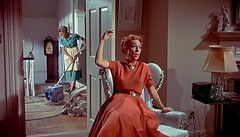
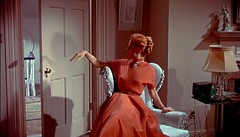
Character development especially benefits in certain areas. Consider the scene in which the busybody best friend attempts a heart-to-heart with Jane Wyman. The friend realizes that the housekeeper can hear them despite the vacuum cleaner and the action moves from this:


to this:


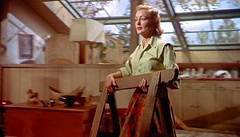
Although Sirk never spells it out, such actions clearly delineate the understood separation between society people and the working class in small-town America and underscores the social conflict resulting from Wyman seeing her gardener. By contrast, Rock Hudson's friends make no such separation and the audience can realize this by comparing the difference between a catered party that is already in full swing at the busybody's house and the more rustic do-it-yourself shindig that happens across town:


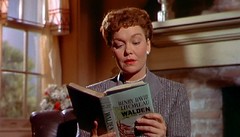
where Wyman discovers Walden:


Perhaps one of the more interesting aspects of All That Heaven Allows is the museum-like quality of much of the setting. Exteriors reveal a very New England-looking autumn, but interiors often appear very serene, with a sense of almost sterile grace. The cold, damp grey of the old mill -- which Wyman prefers to the dowdier yet cozier house Hudson sleeps in -- would be uninviting were it not for the fireplace and the view. Sirk even uses framing to depict a sense of artistic stasis, exampled by this shot in which Wyman looks more like a bust on display than a woman about to go somewhere:


Such images are beautiful and haunting, with an organic quality between them, including a reference to the dead father's trophy on the mantelpiece that appears in a later visual reference on the patio at the party when a neighbor attempts to kiss Jane Wyman. [1] The reference is book-ended by the son's later protests against Rock Hudson marrying into the family, during which he brings up the trophy again, none the wiser that were Wyman to marry a man more acceptable to him and their society friends that she would be reduced to little more than the trophy that she sees reflected in the TV set the children buy her as a consolation to her widowhood. In that moment, the denouement is complete as Wyman realizes the falsity and emptiness of the life that stretches before her if she continues to care what other people think of her.

Although Sirk's approach is more subtle and perhaps craftier than Ford's, each film still exists within the framework afforded it. The distractions that occur within each film serve purposes in conjunction with -- and not contrary to -- the films' best interests. The singing Apache woman may seem at first like a considerable and even jumpy digression from the film's internal movement toward peaceable relations and certainly from its explicit movement toward the end of the coach ride, but it acts as cover for horse thieves to get away, distracting both the audience and the on-screen characters at once through unexpected entertainment. The early, somewhat shocking medium shot/jump cut of the banker warns the audience that something is not right without giving away an important plot point that would have detracted more from the film than the shot does had it been gleaned early.

These considerations promote the pleasure of viewing, the addition of information occurring only when necessary. Perhaps more important, though, to the filmic world is the sense that each film acknowedges that duration is short and fleeting, that the stagecoach ride can only last as long as a town or a memory's hold upon a person. In that sense, each film takes a greater place within the cinematic world, each aware of its own transience and mortality as surely as anyone who ever lived in the Old West; or anyone who has walked the streets of a small town with her thoughts miles away in Walden's Pond; or anyone who has ever noticed how silly and filmic real life can be.

[1] It is impossible for me to determine whether I would have picked this out on my own, so I must give credit where credit is due: former film blogger Andy Horbal first pointed it out in a post complete with screen grabs. Check it out.

Labels: , , ,

Sunday, February 25, 2007

Maternalism & the Female in My Favorite Wife (1940) and Meet Me in St. Louis (1944)

The following discussion is the second in a series of writings designed to broaden my filmic horizons. The first segment of this particular series looked at Modern Times as one representative of the silent film era. The focus this time around is on "classic Hollywood cinema." As defined by David Bordwell and Kristin Thompson in Film Art, classic Hollywood cinema's "conception of narrative depends on the assumption that the action will spring primarily from individual characters as causal agents" and that "the narrative centers on personal psychological causes: decisions, choices, and traits of character." [1] A character has a desire, there's some sort of goal; but, naturally, a counterforce always lies in waits to foible and block the character and make him or her our hero...

In My Favorite Wife and Meet Me in St. Louis the female characters possess what might be considered an unusual amount of strength given the time. Ellen Wagstaff Arden and Esther Smith each exude a strong maternal affection so naturally that it appears to be a given of a desirable woman of the day. Contextual cues also serve to negotiate these gender roles in a way indicative of the call for women, as Lynn Spigel observed, "by popular media to enter traditionally male occupations during the war." [2] Both Mrs. Arden and Ms. Smith were designed to appeal to women of the same class in an adventurousness that still allows room for the boy next door but not without some remediation. The way in each film approaches that design, however, varies considerably as will be seen.

A revisitation of the on-screen charisma exhibited by Cary Grant and Irene Dunne in The Awful Truth (1937) presents the audience yet again with two protagonists. When Ellen Arden turns out not to be dead and lost at sea, the recently remarried Nick Arden finds himself flummoxed and unsure what to do. While Ellen desires to have her husband and her family back, Nick's character holds the flaw that must be ground down and polished: wishy-washiness. By disguising Ellen as the antagonist to Nick's desire to have everything turn out well for everybody (without having to make any decisions), the writers (McCarey, Spewack, McClain and Kanin) reinforce the image of an ideal wife and mother who is essentially perfect, capable of the same things as her male counterparts and only awaiting for her man to grow a little backbone. He must find a classy way to annul his second marriage while she must find a way to re-enter the lives of her husband and children. In order to establish a sense of balance another man also gets thrown into the mix, someone with whom Ellen spent her years "lost at sea." By leveling the romantic playing field, the love story becomes more believable as the audience witnesses how much the idea of his wife spending seven years alone on an island with a strange man pains Nick, who subsequently all but forgets about his new bride.

While Meet Me in St. Louis uses a far more traditional context, its approach to conflict renders it unique and even strange perhaps to anyone unfamiliar with the semi-autobiographical novel by Sally Benson, upon which it is based, or the fascinating history of the city of St. Louis itself. Garland's character is the second of three older daughters hoping to marry the literal boy next door and subject ostensibly to the conflict of the Smith family's possible move to New York City for economic reasons. The move could break the tenuous love affair blossoming between Esther and John. Moods and romantic suggestions color the film through song and dance routines and that same ideal image of womanhood shines through as the men slowly but surely realize that they must speak up in order to get the girl. More importantly, Esther Smith shares an uncommon bond with an uncommon little sister whose psychological havoc with traditional gender roles scores darker notes in this otherwise light fare. While Esther dreams of first kisses and Christmas balls, Tootie executes her toy dolls stoically, even grimly, in an expression quite against the characteristic grain of the future mother, housekeeper or matriarch.

Most interestingly, nobody notices these odd quirks of the youngest daughter's nature, not even in a house with little breathing room and close female relationships. In this way, Tootie's actions symbolize a definite, closeted change in gender roles with a cloudy and indefinite future--a threat to the film's ideology as identified by Bordwell and Thompson. "...Meet Me in St. Louis, like most Hollywood films, seeks to uphold what are conceived as characteristically American values of family unity and life." Pointing out that the film's motif is one of static preservation, they further note that that "the home appears to be a self-sufficient place; other social institutions become peripheral, even threatening." It is also interesting to note that these acts on Tootie's part represent a deep unrest and a rift between the women of the family, a direct result of the external forces at play because of males actions--or inaction. While the outside world prepares for the advent of the 1904 World's Fair (i.e., the Louisiana Purchase Exposition) and horse-drawn carriages give the right of way to motorized vehicles, inside the Smith home "...women are portrayed as the agents of stability. The action in the story constantly returns to the kitchen, where Mrs. Smith and the maid, Katie, work calmly in the midst of small crises. The men present the threat to the family's unity."


Each of these films employ a mixture of perceptual and mental subjectivity. After witnessing the physical prowess of the man with which his wife lived on an island, Nick Arden's mental torture manifests itself in a hallucinatory image at once funny and indicative of his state of mind. Many of Minnelli's musical numbers could be construed as mental subjectivity as the audience listens to Esther's thoughts and ruminations through song. It might be said that while Meet Me in St. Louis relies heavily on mental subjectivity and My Favorite Wife upon perceptual subjectivity that each operate differently within their largely omniscient point of view. The audience almost always knows more than the Ardens at any given time, which is just part of the fun, but these two characters catch up on the facts as the story unfolds. The Smith sisters and their family and beaus are considerably more vague; the audience sees into each private life, but the web never quite connects on the screen. If the audience only considers the desires of Esther, though, the narration then becomes more restricted to her character's viewpoint, waiting with her to see if John Truett will make up his mind and things will work out somewhere between St. Louis and New York. In this sense, the omniscient view point reinforces the use of each character in its distinct position within the framework of the film's ideology and ostensible recipe for romance.

"Straight musicals," Bordwell and Thompson write of films like Meet Me in St. Louis, "are often romantic comedies, in which characters typically trace the progress of their courtship by breaking into song to express their fears, longings, and joys." Bordwell and Thomspon also note the connection between musicals and children's fare, a decidedly good point looking at Minnelli's film as a whole. Not only do children appear in the film prominently, but the recurrent idea of resistance to change conjures a romantic perception of childhood innocence and youth in general as something to be preserved and cherished lest it be lost forever. It often feels that musicals and love stories go so hand-in-hand because of the imperfect nature of words when trying to express strong feelings. Actions always speak louder than words, but what satisfaction can an audience derive from a love story in which no words connoting love or intimacy are exchanged? By the same token musicals provide more than a means to that expression; they also allow for intrigue between the characters to build as the audience becomes ever more privy to the character's desires and ever more aware of the growing love interest's ignorance. This romantic plot line insinuates itself naturally into the musical form--even when dealing with supposedly revolutionary characters in Hair (1979) or a platonic historical figure in Jesus Christ Superstar (1973) or a desperate and ultimately doomed love affair the likes of Moulin Rouge! (2001).

Bereft of musical numbers, romantic comedies--particularly the "screwball" comedy--employ more plot twists and devices to keep the audience intrigued. In order for a love story to be believable, both parties (according to Hollywood) must hold more than a passing interest in each other; they must each at least try to make the relationship work, even if only the audience can fully appreciate their attempts. Or, to quote the authors yet again, "The screwball comedy traditionally sets up a thematic opposition between a stiff, unyielding social milieu and characters' urges for freedom and innocent zaniness." The judge in the courtroom represents the law and authority and an indifference to the qualities that make this romance work--love, forgiveness and spontaneity--a recurring obstacle in comedies from His Girl Friday (1940) to Some Like it Hot (1959). The use of certain Foley sounds, such as pings that sound when something racy has been implied, also seem to be the sole province of the screwball comedy; and, unlike the musical genre, the story determines the film's general reception as the audience relies more on the character's interaction rather than their ability to emote through song and dance routines.

To return to Spigel's words concerning the changing gender roles in World War II's America for a moment, it seems a good bet that a lot of the dialogue in My Favorite Wife was crafted with that shift in mind. The judge/authority figure frowns upon Ellen Arden's role, but is more confused than condemning. She retains her maiden name (Ellen Wagstaff Arden) perhaps as part of her role as a former Southern belle, but probably also symptomatically of a new way of viewing the woman's role in a marriage. Her role as a mother demonstrates itself as an egalitarian negotiation between her and her husband that keeps what's best for the children in mind but does not usurp the romantic ideal of being a woman first and a mother second--despite the twin beds in the marital chamber. [3] In other words, explicitly a woman has to grapple with her various roles but implicitly a woman's strength of reason and resolve create a home in which a man can either snuggle up or leave to find a new mate. In contrast, the maternal strength in Meet Me in St. Louis manifests itself much differently. If the outside forces of the world--a world run by men--present a threat to that strength, the period piece musical acquires a new dimension non-existent in the screwball comedy, a defiance of a perceived societal shift. Where the screwball comedy interacts with that shift, the musical seeks to trap and distill it--crystallize it--and let the world see what it is that they will be forever missing.

[1] Bordwell, David and Kristin Thompson. Film Art: An Introduction. Eighth Ed. McGraw Hill: University of Wisconsin. 2006.

[2] Spigel, Lynn. Make Room for TV: Television and the Family Ideal in Postwar America. The University of Chicago Press: 1992. (All excerpts Chapter 2: Television in the Family Circle)

[3] This ideal female image would re-prioritize those roles in the post-war era. Spigel discusses the reaction to the undermining of the male's assumed authority in the household and workplace thus: "...women were given a highly constraining solution to the changing roles of gender and sexual identity...Marynia Farnham and Ferdinand Lundberg's The Modern Woman: The Lost Sex (1947) gave professional, psychological status to the housewife image, claiming that the essential function of women was that of caretaker, mother, and sexual partner. Those women who took paid employment in the outside world would defy the natural order of things and become neurotics...The domestic woman needed to save her energy for housekeeping, childrearing, and an active (monagamous) sex life with her husband."

Labels: , , ,

Friday, February 23, 2007

Modern Times & The Post-Industrial American Dream

The following discussion falls into a series of writings which I will be posting between now and May. It incorporates language that I have used very little of in the past. I am expanding my filmic horizons, a lot of which will be informed by the eighth edition of David Bordwell and Kristin Thompson's Film Art. (That's the one with a still from Caché on the cover, for those interested.) I expect that as this educational experience progresses the language will become less foreign and more a fluent part of my writing.

This is the first entry. The second is a look at maternalism in the '40s classic films
My Favorite Wife and Meet Me in St. Louis...

If you polled an informed film audience as to which Chaplin film was the best, you'd invariably meet with obstinant answers pointing to Buster Keaton and Harold Lloyd as the more talented comedians of the day. Luckily, I'm not interested in anything hued with hissing hyperbole, especially not regarding the bygone days of silent film and its attunement to mass culture. What does interest me, though, are general impressions of this particular take of Chaplin's. Often labeled as prescient or foreshadowing, a note that I barely brushed upon in my initial, synoptic review, this film has summoned me back for a closer look. I invite you to do the same with me, keeping in mind that the film was made by a man who, for better or for worse, outshone his peers and engraved himself indelibly upon mass consciousness as a classic character and filmmaker--a feat a lot of people have wasted good money to learn.

Perhaps right from the get-go, Chaplin aimed to do just that. Modern Times' initial placement of the Tramp in a factory, working hard--a lot of elbow grease--just to keep up with a gargantuan and largely symbolic machine conjures an instant contrast of the film's broader, diegetic look at the world. This is the world of the blue collar worker, the entry-level serf in general, but focused upon the specific events of the Tramp's life in each particular setting. As the scenarios shift, it's important to remember that Chaplin keeps the action and the camera specific. As a result, we care when the Tramp's unable to keep pace with the inhumanly fast machine and loses his job and must find another or face starvation. It's not just his antics that render him sympathetic, even loveable. In this instance, the Tramp could have left his job forlorn and sweetly helpless, but he chooses instead to fight back.

By returning to that essential conflict between the dehumanizing setting of the industrialized labor force and the privations of a costly "freedom" from the workplace, Chaplin eliminates the need to hammer home the lack of a happy medium. Our hero is a hero because no matter what he tries, he will fail, and yet he doesn't give up--an understatement about the inability to be truly happy indeed, and perhaps the strongest evidence of the Tramp's threat to capitalism. The story's carefully chosen boundaries cue the audience; contextually, we understand that whether a pursuant of the American dream works in a steel mill, a shipyard, a department store, a machinist's or a restaurant that the dream he chases operates as a relentless and teasing pahntom--as elusive as the "happily ever after" ideal it connotes.

Upon that rusty spindle winds this comedy and love story between the Tramp and a feisty street urchin. By keeping the Tramp and his girl's predicaments and foibles (and their reactions) in the present, Chaplin also syncopates the audience's emotional responses with the events on screen. Partly through the use of fantastic sequences (such as the Tramp finally succumbing to the machine's pull and being rolled through it, the suspension of disbelief takes on a new dimension that allows the fact of the Tramp's firing to retain some element of surprise.


The balletic execution of the scene inside the machine strikes an iconic chord that renders the metaphor of the workingman's doldrum days from birth to death laughable and poignant at once; and so, even though the Tramp's job loss itself could be construed as perfectly logical, the subsequent disappointment is delicate, manifold. More importantly, none of the co-workers (and certainly not the boss) witness this swan dive into the machine. At this juncture, the relationship between the Tramp and the audience becomes sacrosanct; all other characters within the film are of secondary importance to his plight. The audience wants the Tramp to win the day.

After having taken such pains to elicit audience loyalty through cinematography and story choices, several other factors serve to reinforce some very simple distinctions. The sensitive Tramp has no qualms about giving the street urchin a fur coat in which to snuggle; but he is still a poor man, and he wears the implication even as he roller skates in the department store late at night. The camera employs wide-angle shots to impart a sense of danger, of precariousness, as he skates ever closer to the edge of the unguarded balcony, a sign that the hero is brave and perhaps in need of a little protection from himself. That sense of danger plays throughout the film, though, and it often lies outside of the Tramp's means to tame it: the factory owner's Big Brother-like monitoring and pushing of his machine to full production capacity; the Tramp's nervous breakdown that places him yet again in the care of mental and social workers and inadvertently triggers a jailbreak; and the peril of working in a department store while it's being robbed by men on the verge of starvation themselves. To these scenes Chaplin entrusts the Tramp's relative ignorance of the world against which he is defenseless, cueing the audience yet again not only with plot points (one of the robbers is a former steel mill co-woker) but also with character blinds.

The explicit meaning derivates from the film's surface scouring of the American dream, acting in accordance with its referential meaning--that working hard and saving pennies will earn enough to make such a dream a reality. The implicit meaning, though, speaks of a deep restlessness obscured by society but ever-present and ultimately a real threat to the happiness of anyone who buys into such a dream as truth. In fact, by equating the "happily ever after" scenario with that dream, Chaplin seems to be suggesting that all such idealistic pursuits should be understood to be the stuff of films and storybooks, and not the larger reality of America's working class. If so, he nearly got away with it cleanly.

In tune with the atmosphere of the Industrialized Depression, Modern Times feels symptomatic of the concern about the exponential growth of the middle classes. Only thirteen years after the film's release, George Orwell would publish 1984 and ergonomics would officially become an applied science. While Orwell's text would be considerably darker than Chaplin's fare, both stem from a conflict between individual freedom and the ever-narrowing alternative in a society purporting to be free yet camouflaging what precisely that means. As ever, it is up to the protagonist to define it for himself.


On one last note, while looking for parallels between Modern Times and more contemporary media, several suggestions bubble to the surface. The Norma Raes and Gung Hos of this world aside, perhaps my favorite connection would be Laverne & Shirley. The parody of two working women chasing the Tramp's unattainable dream of freedom through labor and equality seems likely, especially with Lenny and Squiggy as the only love interests in sight. American dream, what?

Labels: , ,